
Share this
Chemical Compatibility: Matching Fillers to Corrosive Products
by APEX Filling Systems on Nov 14, 2025
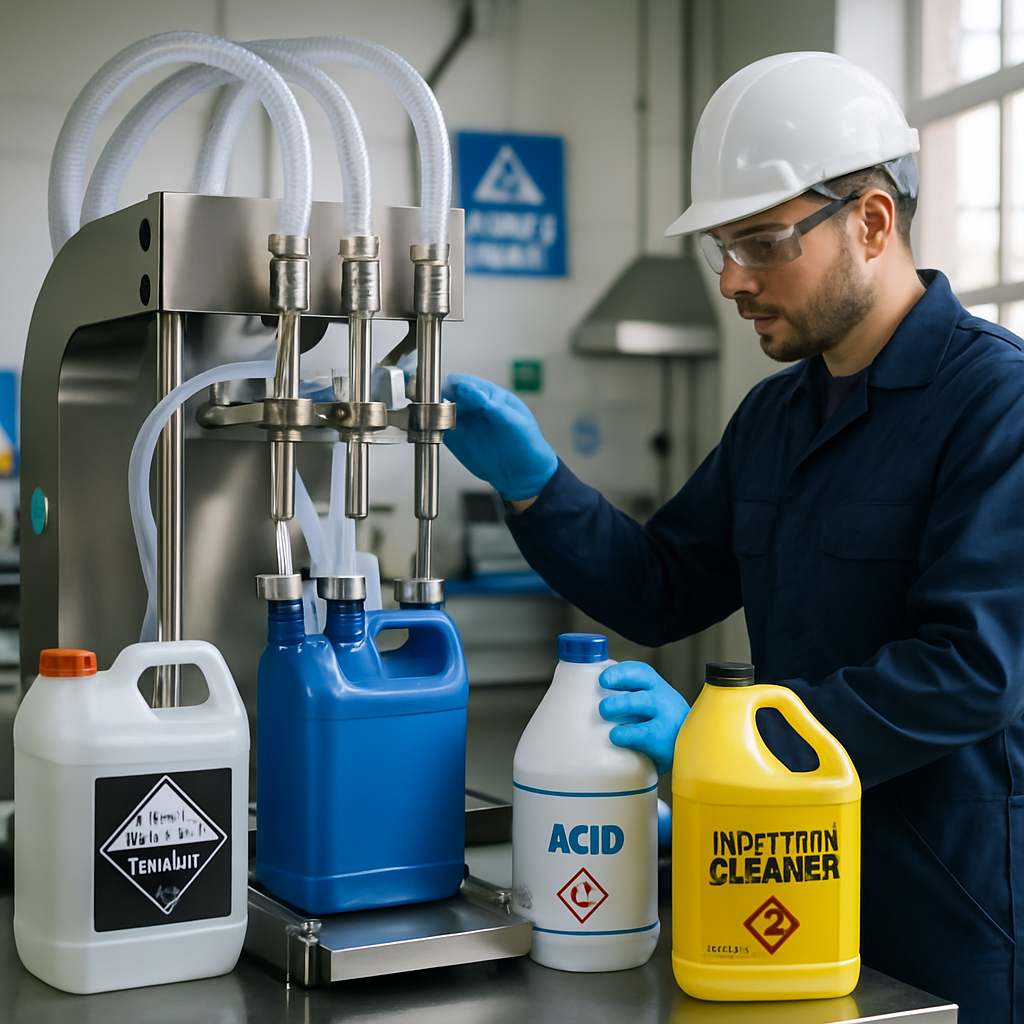
In the world of chemical manufacturing and packaging, one of the most critical—and often underestimated—factors is chemical compatibility. Selecting the right liquid filling equipment for corrosive substances isn’t just a matter of operational efficiency; it’s essential for safety, equipment longevity, and regulatory compliance. If you're packaging aggressive chemicals like acids, bleach, solvents, or industrial cleaners, understanding how to match your filling machinery to your product is key to a reliable, scalable, and safe operation.
Why Chemical Compatibility Matters
Corrosive products can degrade or destroy unprotected components within a filling machine. Over time, this leads to:
-
Equipment failure
-
Increased downtime
-
Costly repairs or replacements
-
Operator safety risks
-
Cross-contamination potential
Using incompatible materials in your filling line can also expose your operation to environmental hazards, OSHA violations, and liability issues.
Key Considerations for Corrosive Product Filling
To ensure optimal compatibility between your filling system and corrosive products, here are five essential factors to consider:
1. Filler Material Selection
The most crucial aspect is choosing components that resist chemical breakdown. This typically means:
-
HDPE (High-Density Polyethylene) frames and contact parts
-
Polypropylene or Teflon-lined tubing
-
PVC or CPVC manifolds
-
316L stainless steel in rare cases where corrosion-resistant metals are sufficient
Different chemicals attack different materials. For example, strong acids may degrade stainless steel but remain stable in polypropylene or Teflon. Always consult a chemical compatibility chart before making material decisions.
2. Non-Metallic Flow Paths
In many corrosive applications, no metal should contact the product. This makes non-metallic pumps, valves, and seals critical. Pneumatic diaphragm pumps and peristaltic pumps are often used in these cases due to their fully enclosed and non-reactive flow paths.
3. Sealing and Containment Systems
Look for machines that incorporate:
-
Corrosion-proof gaskets and seals
-
Fume extraction hoods
-
Drip trays and overflow sensors
These components help prevent spills, fumes, and contamination—especially important when filling highly reactive or volatile products.
4. Ease of Cleanability
Corrosive product residue can become even more aggressive over time. Machines designed with quick-disconnect fittings, drainage systems, and clean-in-place (CIP) capabilities can help maintain safety and prevent premature wear.
5. Ventilation and Safety Integration
Filling corrosive products often requires added safeguards such as:
-
Built-in exhaust ports
-
Explosion-proof enclosures
-
Grounding and bonding mechanisms for flammable corrosives
Integrating these systems not only protects your operators—it also improves your facility’s compliance with fire, safety, and EPA regulations.
Best Machine Types for Corrosive Applications
While machine selection ultimately depends on your fill volume, viscosity, and throughput needs, certain filler types are more commonly used for corrosive products:
-
Time Gravity Fillers – Ideal for thin, free-flowing corrosives. These can be built from corrosion-resistant plastics and require minimal contact between the product and moving parts.
-
Overflow Fillers with PVC Construction – Provide consistent visual fills, often used for household cleaners and disinfectants packaged in transparent bottles.
-
Piston Fillers (in limited cases) – When dealing with corrosive gels or pastes, piston fillers can work if built entirely from chemically resistant materials.
-
Peristaltic Fillers – Excellent for precision micro- to medium-dosing applications with high chemical compatibility due to single-use tubing.
Partnering with a Manufacturer That Understands Corrosives
Ultimately, choosing a filling system for corrosive products means more than just buying a machine—it’s about finding a packaging partner who understands the chemistry behind your product and can engineer a solution that meets your safety, compliance, and production goals.
At Apex Filling Systems, we specialize in designing corrosion-resistant filling machines tailored for harsh chemicals, acids, industrial cleaners, and more. We’ll guide you through chemical compatibility, component selection, and safety integrations to ensure long-term performance with minimal maintenance.
Ready to Package Corrosive Liquids the Right Way?
If you're struggling to find the right filling equipment for aggressive products, talk to our experts. We’ll help you engineer a system that prioritizes durability, operator safety, and compliance—without compromising speed or accuracy.
Share this
- Help First (97)
- Apex Filling Systems (78)
- Filling Equipment (76)
- Informational (70)
- Automatic Filling Machine (59)
- Industry Insights (59)
- Packaging Equipment (47)
- About Apex (20)
- American Made Goods (20)
- Fillers (18)
- Automatic Capping (11)
- Apex Filling (10)
- Apex (7)
- Uncategorized (5)
- Apex Team (3)
- Apex Family (2)
- Absolute Truth (1)
- Apex Way (1)
- Petroleum (1)
- oil (1)
- August 2026 (1)
- July 2026 (5)
- June 2026 (4)
- May 2026 (5)
- April 2026 (4)
- March 2026 (4)
- February 2026 (1)
- January 2026 (2)
- December 2025 (4)
- November 2025 (4)
- October 2025 (5)
- September 2025 (3)
- June 2025 (3)
- May 2025 (6)
- April 2025 (10)
- March 2025 (10)
- February 2025 (12)
- January 2025 (14)
- December 2024 (1)
- November 2024 (4)
- October 2024 (4)
- September 2024 (2)
- August 2024 (1)
- July 2024 (4)
- October 2022 (1)
- September 2022 (1)
- June 2022 (1)
- October 2021 (2)
- June 2021 (1)
- May 2021 (1)
- April 2021 (2)
- March 2021 (2)
- February 2021 (1)
- January 2021 (2)
- November 2020 (1)
- October 2020 (1)
- September 2020 (2)
- August 2020 (1)
- July 2020 (1)
- June 2020 (1)
- May 2020 (1)
- April 2020 (2)
- March 2020 (2)
- February 2020 (2)
- January 2020 (3)
- December 2019 (2)
- November 2019 (6)
- October 2019 (4)
- September 2019 (3)
- August 2019 (6)
- July 2019 (2)
- April 2019 (1)
- February 2019 (1)
- January 2019 (7)
- December 2018 (6)
- November 2018 (5)
- October 2018 (2)
- September 2018 (2)
- August 2018 (1)
- July 2018 (3)
- May 2018 (2)
- April 2018 (1)
- March 2018 (2)
- February 2018 (2)
- January 2018 (2)