
Share this
How Food & Beverage Trends Are Changing Filling Equipment Requirements
by APEX Filling Systems on Jun 19, 2026
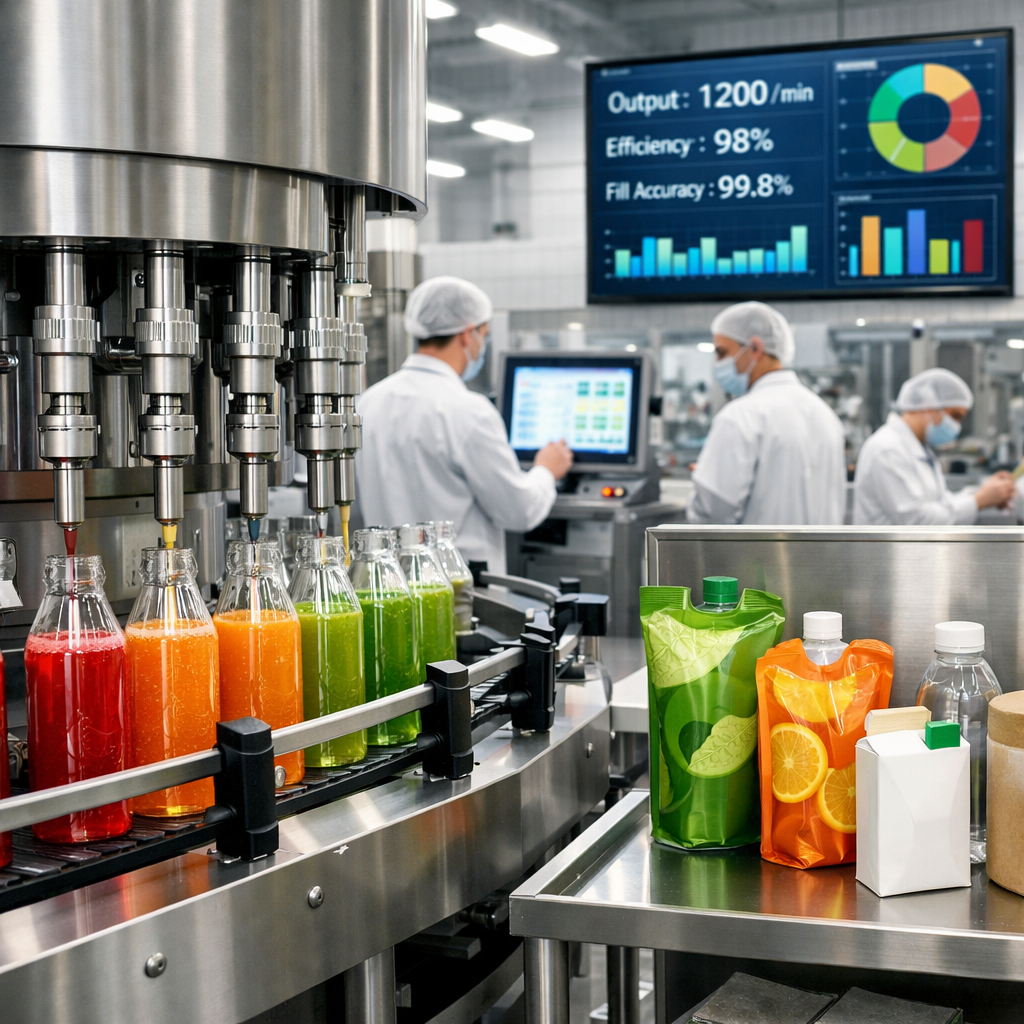
The food and beverage industry has always been driven by consumer preferences, but today's market is evolving faster than ever. Shifting purchasing habits, new product categories, sustainability initiatives, and increased demand for convenience are forcing manufacturers to rethink their production strategies.
As a result, filling equipment requirements are changing as well.
Manufacturers can no longer rely on equipment designed solely for high-volume production of a few standard products. Modern food and beverage operations require filling systems that are more flexible, precise, connected, and adaptable than ever before.
Let's explore the major food and beverage trends shaping the industry in 2026 and beyond—and how they are influencing filling equipment requirements.
The New Reality of Food & Beverage Manufacturing
Today's consumers want:
- More product choices
- Health-focused ingredients
- Sustainable packaging
- Convenient formats
- Premium experiences
- Faster product innovation
For manufacturers, these expectations translate into:
- More SKUs
- Smaller batch sizes
- Frequent product launches
- Diverse packaging formats
- Increased quality standards
Meeting these demands requires filling equipment that can keep pace with a rapidly changing market.
Trend 1: More Product Variety and SKU Proliferation
Walk down any grocery aisle and you'll notice a dramatic increase in product variety.
Beverage companies now offer:
- Low-sugar options
- Functional beverages
- Energy drinks
- Protein drinks
- Enhanced waters
- Plant-based alternatives
Food manufacturers are introducing:
- Specialty sauces
- Premium condiments
- Organic products
- Limited-edition flavors
This growth in product variety creates new challenges for packaging operations.
What Filling Equipment Needs
Modern systems must support:
Fast Changeovers
Manufacturers need to move quickly between products without lengthy downtime.
Features include:
- Recipe-based controls
- Tool-less adjustments
- Automated setup changes
Flexible Product Handling
Equipment must accommodate:
- Thin liquids
- Thick sauces
- Products with particulates
- Foaming beverages
Flexibility has become one of the most important characteristics of modern filling equipment.
Trend 2: Growth of Functional and Specialty Beverages
The functional beverage market continues to expand rapidly.
Products now include:
- Vitamin-enhanced beverages
- Energy drinks
- Electrolyte drinks
- Probiotic beverages
- Protein drinks
- CBD-infused beverages where permitted
These products often contain unique ingredients that create filling challenges.
Equipment Considerations
Manufacturers may require:
Precise Fill Control
High-value ingredients increase the importance of fill accuracy.
Even small overfills can significantly impact profitability.
Gentle Product Handling
Some ingredients are sensitive to:
- Excess agitation
- Shearing
- Temperature changes
Filling systems must protect product integrity throughout the packaging process.
Trend 3: Demand for Sustainable Packaging
Sustainability is influencing nearly every aspect of food and beverage packaging.
Manufacturers are adopting:
- Lightweight bottles
- Recyclable materials
- Refillable containers
- Flexible packaging formats
- Post-consumer recycled materials
While these packaging options support environmental goals, they can create production challenges.
What Filling Equipment Needs
Modern filling systems must accommodate:
Lightweight Containers
Lighter packaging may be more susceptible to:
- Deformation
- Instability
- Misalignment
Equipment must provide precise container handling without causing damage.
Reduced Waste Filling
Accurate filling helps reduce:
- Product giveaway
- Packaging waste
- Sustainability-related costs
Precision is increasingly tied to ESG performance.
Trend 4: Increased Focus on Food Safety
Consumers and regulators continue to place greater emphasis on food safety and traceability.
Manufacturers are expected to maintain strict control over:
- Sanitation
- Contamination prevention
- Product consistency
- Traceability
Equipment Requirements
Sanitary Design
Modern food-grade equipment should feature:
- Stainless steel construction
- Hygienic welds
- Easy-to-clean surfaces
- Minimal product traps
Clean-in-Place (CIP) Compatibility
Many facilities now prioritize systems that support efficient cleaning without extensive disassembly.
Benefits include:
- Reduced downtime
- Improved sanitation
- Lower labor requirements
Trend 5: Smaller Batch Production
Food and beverage companies are launching products more frequently than ever.
This trend creates demand for:
- Pilot production runs
- Seasonal products
- Regional offerings
- Test-market products
Filling Equipment Must Offer
Production Flexibility
Manufacturers need equipment capable of handling:
- Short production runs
- Frequent product changes
- Variable production volumes
Flexible filling systems provide a significant competitive advantage.
Trend 6: Labor Challenges Continue
Labor shortages remain a concern across manufacturing.
Food and beverage facilities increasingly struggle to find and retain skilled workers.
Equipment Requirements
Automation
Manufacturers are investing in:
- Automated filling systems
- Robotic material handling
- Automated capping and labeling
Automation reduces labor dependency while improving consistency.
User-Friendly Controls
Modern HMIs help operators:
- Learn systems faster
- Reduce errors
- Improve productivity
Simplified operation is becoming a major purchasing consideration.
Trend 7: Smart Manufacturing and Data Visibility
Food and beverage manufacturers are embracing Industry 4.0 technologies.
Production managers want real-time insights into:
- Throughput
- Fill accuracy
- Downtime
- OEE performance
- Maintenance requirements
Smart Filling Line Features
Today's systems increasingly include:
Real-Time Dashboards
Operators can monitor:
- Production rates
- Equipment status
- Quality metrics
Predictive Maintenance
Advanced systems detect issues before failures occur, reducing downtime and improving reliability.
Trend 8: Growth in Alternative Packaging Formats
Traditional bottles remain popular, but manufacturers are expanding into:
- Pouches
- Refill packs
- Cartons
- Specialty containers
These formats require greater versatility from filling equipment.
Equipment Considerations
Manufacturers should prioritize systems capable of:
- Accommodating multiple container types
- Supporting future packaging innovations
- Adapting to changing market demands
Versatility helps protect long-term equipment investments.
Trend 9: Increased Pressure to Improve Efficiency
Rising costs for ingredients, labor, transportation, and utilities are pushing manufacturers to improve productivity.
Filling equipment is expected to contribute by:
- Reducing waste
- Increasing throughput
- Improving uptime
- Lowering maintenance costs
The focus is shifting from simply producing more to producing more efficiently.
What Food & Beverage Manufacturers Should Look for in 2026
When evaluating filling equipment, manufacturers should prioritize:
Flexibility
Can it handle multiple products and packaging formats?
Precision
Can it minimize waste and ensure consistency?
Automation
Can it reduce labor requirements and improve throughput?
Scalability
Can it support future growth?
Connectivity
Can it integrate with smart factory initiatives?
Sustainability
Can it support environmentally responsible packaging strategies?
The answers to these questions will determine how well a filling line performs in the years ahead.
Final Thoughts
Food and beverage trends are reshaping the requirements for modern filling equipment.
As consumer preferences continue to evolve, manufacturers need systems that are:
- Flexible
- Accurate
- Efficient
- Connected
- Scalable
The most successful operations will be those that view filling equipment not as a standalone machine, but as a strategic asset capable of adapting to changing market demands.
Investing in the right equipment today can help manufacturers remain competitive, efficient, and profitable well into the future.
Ready to Adapt Your Packaging Line for What's Next?
Whether you're filling beverages, sauces, dressings, oils, or specialty food products, Apex Filling Systems can help you design a filling, capping, and labeling solution built to meet the evolving demands of the food and beverage industry.
Share this
- Help First (97)
- Apex Filling Systems (78)
- Filling Equipment (76)
- Informational (70)
- Automatic Filling Machine (59)
- Industry Insights (59)
- Packaging Equipment (47)
- About Apex (20)
- American Made Goods (20)
- Fillers (18)
- Automatic Capping (11)
- Apex Filling (10)
- Apex (7)
- Uncategorized (5)
- Apex Team (3)
- Apex Family (2)
- Absolute Truth (1)
- Apex Way (1)
- Petroleum (1)
- oil (1)
- August 2026 (1)
- July 2026 (5)
- June 2026 (4)
- May 2026 (5)
- April 2026 (4)
- March 2026 (4)
- February 2026 (1)
- January 2026 (2)
- December 2025 (4)
- November 2025 (4)
- October 2025 (5)
- September 2025 (3)
- June 2025 (3)
- May 2025 (6)
- April 2025 (10)
- March 2025 (10)
- February 2025 (12)
- January 2025 (14)
- December 2024 (1)
- November 2024 (4)
- October 2024 (4)
- September 2024 (2)
- August 2024 (1)
- July 2024 (4)
- October 2022 (1)
- September 2022 (1)
- June 2022 (1)
- October 2021 (2)
- June 2021 (1)
- May 2021 (1)
- April 2021 (2)
- March 2021 (2)
- February 2021 (1)
- January 2021 (2)
- November 2020 (1)
- October 2020 (1)
- September 2020 (2)
- August 2020 (1)
- July 2020 (1)
- June 2020 (1)
- May 2020 (1)
- April 2020 (2)
- March 2020 (2)
- February 2020 (2)
- January 2020 (3)
- December 2019 (2)
- November 2019 (6)
- October 2019 (4)
- September 2019 (3)
- August 2019 (6)
- July 2019 (2)
- April 2019 (1)
- February 2019 (1)
- January 2019 (7)
- December 2018 (6)
- November 2018 (5)
- October 2018 (2)
- September 2018 (2)
- August 2018 (1)
- July 2018 (3)
- May 2018 (2)
- April 2018 (1)
- March 2018 (2)
- February 2018 (2)
- January 2018 (2)