
Share this
How to Choose the Right Liquid Filling Machine for Your Product Viscosity
by APEX Filling Systems on Sep 12, 2025
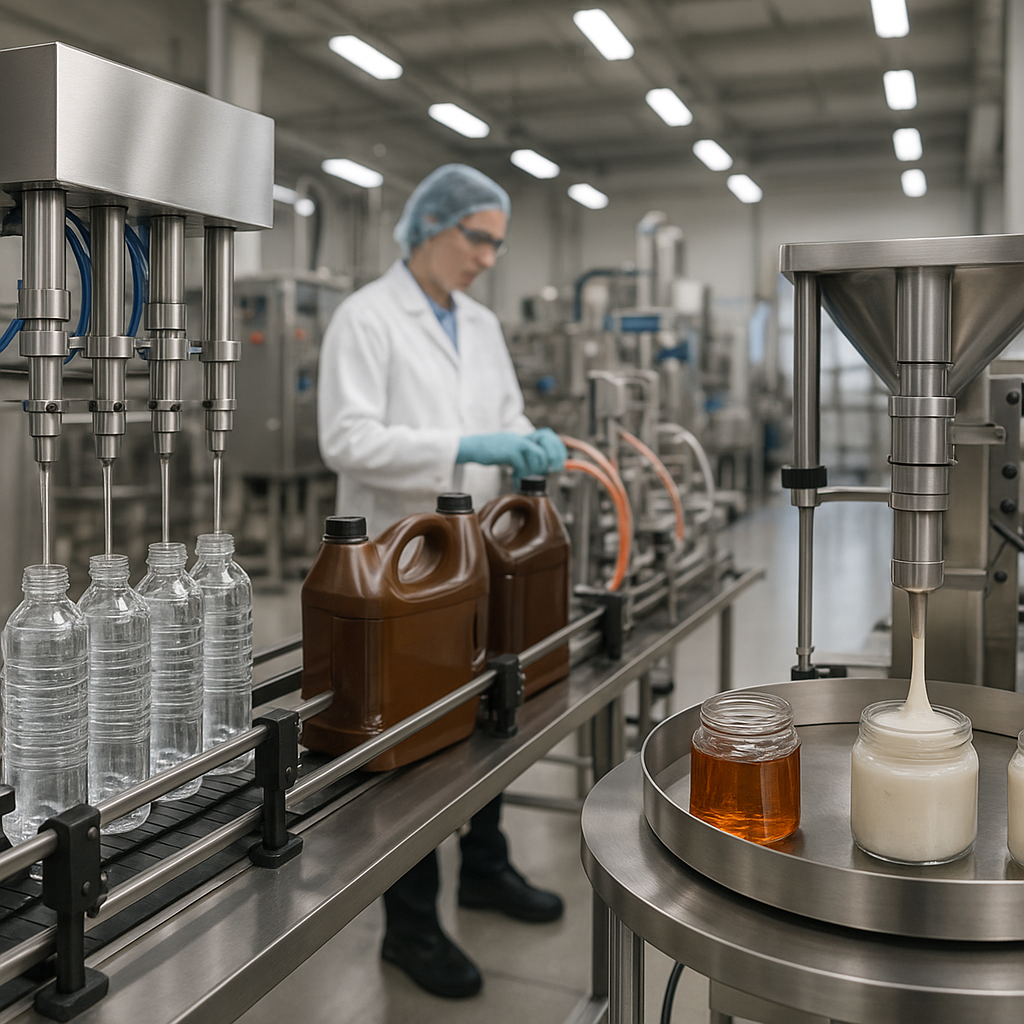
When it comes to selecting the ideal liquid filling machine for your production line, one of the most critical — and often overlooked — factors is product viscosity. Whether you’re packaging water-thin liquids, thick pastes, or something in between, the viscosity of your product directly affects the performance, efficiency, and accuracy of your filling system.
Choosing the wrong filler for your product’s flow characteristics can lead to messy spills, inconsistent fills, excessive wear on components, and costly downtime. Let’s explore how viscosity plays a role in filling performance and which machine types are best suited for each viscosity range.
What Is Viscosity?
Viscosity is a measure of a liquid’s resistance to flow. A product with low viscosity flows easily, like water or alcohol. A high-viscosity product moves more slowly and may be thicker or stickier — think of honey, shampoo, or peanut butter.
In packaging, understanding viscosity is essential because it dictates:
-
How a liquid enters and exits the filler
-
The need for pumps, pressure, or gravity assistance
-
The risk of dripping, foaming, or splashing
-
The fill speed and volume control required
Common Filler Types and Their Viscosity Match
Here’s a quick breakdown of common filling technologies and what viscosity ranges they perform best with:
| Filling Machine Type | Best For | Viscosity Range |
|---|---|---|
| Gravity Fillers | Water, juice, cleaners | Low |
| Overflow Fillers | Foamy products (e.g. soaps) | Low to medium |
| Pump Fillers | Oils, syrups, gels | Medium to high |
| Piston Fillers | Lotions, creams, sauces | Medium to very high |
Let’s take a closer look at each option.
Gravity Fillers – Simple, Efficient, and Cost-Effective
Ideal for: Thin, free-flowing liquids
Gravity fillers rely on the force of gravity to move liquid from the supply tank into the container. They are highly efficient for non-viscous products and are often chosen for bottling water, alcohol, cleaning agents, and other similar fluids.
Pros:
-
Fewer moving parts
-
Lower maintenance
-
Excellent for high-volume, low-viscosity products
Cons:
-
Not ideal for thicker products
-
May require longer fill times with certain container shapes
Overflow Fillers – The Go-To for Foamy Liquids
Ideal for: Low- to medium-viscosity, foamy products
Overflow filling machines use a recirculating method that fills bottles to a consistent level by allowing excess product to “overflow” back into the tank. They’re great for shampoos, soaps, and other liquids where a uniform fill level is more important than exact volume.
Pros:
-
Visually consistent fill levels
-
Manages foaming effectively
-
Good speed for small to medium operations
Cons:
-
Not ideal for thick liquids
-
May require more cleaning due to overflow
Pump Fillers – Flexible for Diverse Applications
Ideal for: Medium- to high-viscosity liquids
Pump fillers use gear pumps, lobe pumps, or peristaltic pumps to move product into containers. They provide control over fill volume and speed and are highly customizable based on the product and container type.
Pros:
-
Handles a broad range of viscosities
-
Highly accurate and repeatable
-
Adaptable to specialty applications (e.g., corrosives or delicate products)
Cons:
-
May require more maintenance
-
Pumps must be matched to specific product characteristics
Piston Fillers – Precision for Thick and Chunky Products
Ideal for: High-viscosity or chunky products
Piston fillers use a mechanical piston to draw product into a chamber and then push it out into the container. They’re the best choice for peanut butter, pastes, heavy creams, and even products with particulates like salsa or yogurt with fruit chunks.
Pros:
-
High fill accuracy
-
Excellent for thick or chunky products
-
Can handle large fill volumes
Cons:
-
May require more complex cleaning
-
Larger footprint than other filler types
Final Thoughts: Matching Machine to Material
When choosing the right filler, consider the full picture:
-
Viscosity is your starting point
-
Foaming, particulates, container size, and fill volume are also crucial
-
Sanitation requirements (like for food or pharma) may rule out certain machines
-
Flexibility needs — if you run multiple product types, a versatile filler may be the better investment
At Apex Filling Systems, we specialize in helping manufacturers find the right equipment for their specific product — whether you’re bottling water, essential oils, or heavy-duty chemicals. Our experts are ready to evaluate your needs and recommend a tailored solution for maximum efficiency and ROI.
Ready to Talk Fillers?
If you're unsure which machine is best for your product line, our team is here to help. Contact Apex for a free consultation and let’s find the right solution for your product viscosity challenges.
Share this
- Help First (97)
- Apex Filling Systems (78)
- Filling Equipment (76)
- Informational (70)
- Automatic Filling Machine (59)
- Industry Insights (59)
- Packaging Equipment (47)
- About Apex (20)
- American Made Goods (20)
- Fillers (18)
- Automatic Capping (11)
- Apex Filling (10)
- Apex (7)
- Uncategorized (5)
- Apex Team (3)
- Apex Family (2)
- Absolute Truth (1)
- Apex Way (1)
- Petroleum (1)
- oil (1)
- August 2026 (1)
- July 2026 (5)
- June 2026 (4)
- May 2026 (5)
- April 2026 (4)
- March 2026 (4)
- February 2026 (1)
- January 2026 (2)
- December 2025 (4)
- November 2025 (4)
- October 2025 (5)
- September 2025 (3)
- June 2025 (3)
- May 2025 (6)
- April 2025 (10)
- March 2025 (10)
- February 2025 (12)
- January 2025 (14)
- December 2024 (1)
- November 2024 (4)
- October 2024 (4)
- September 2024 (2)
- August 2024 (1)
- July 2024 (4)
- October 2022 (1)
- September 2022 (1)
- June 2022 (1)
- October 2021 (2)
- June 2021 (1)
- May 2021 (1)
- April 2021 (2)
- March 2021 (2)
- February 2021 (1)
- January 2021 (2)
- November 2020 (1)
- October 2020 (1)
- September 2020 (2)
- August 2020 (1)
- July 2020 (1)
- June 2020 (1)
- May 2020 (1)
- April 2020 (2)
- March 2020 (2)
- February 2020 (2)
- January 2020 (3)
- December 2019 (2)
- November 2019 (6)
- October 2019 (4)
- September 2019 (3)
- August 2019 (6)
- July 2019 (2)
- April 2019 (1)
- February 2019 (1)
- January 2019 (7)
- December 2018 (6)
- November 2018 (5)
- October 2018 (2)
- September 2018 (2)
- August 2018 (1)
- July 2018 (3)
- May 2018 (2)
- April 2018 (1)
- March 2018 (2)
- February 2018 (2)
- January 2018 (2)