
Share this
Is Your Filling Line Future‑Proof? A Look at Emerging Technologies
by APEX Filling Systems on Oct 31, 2025
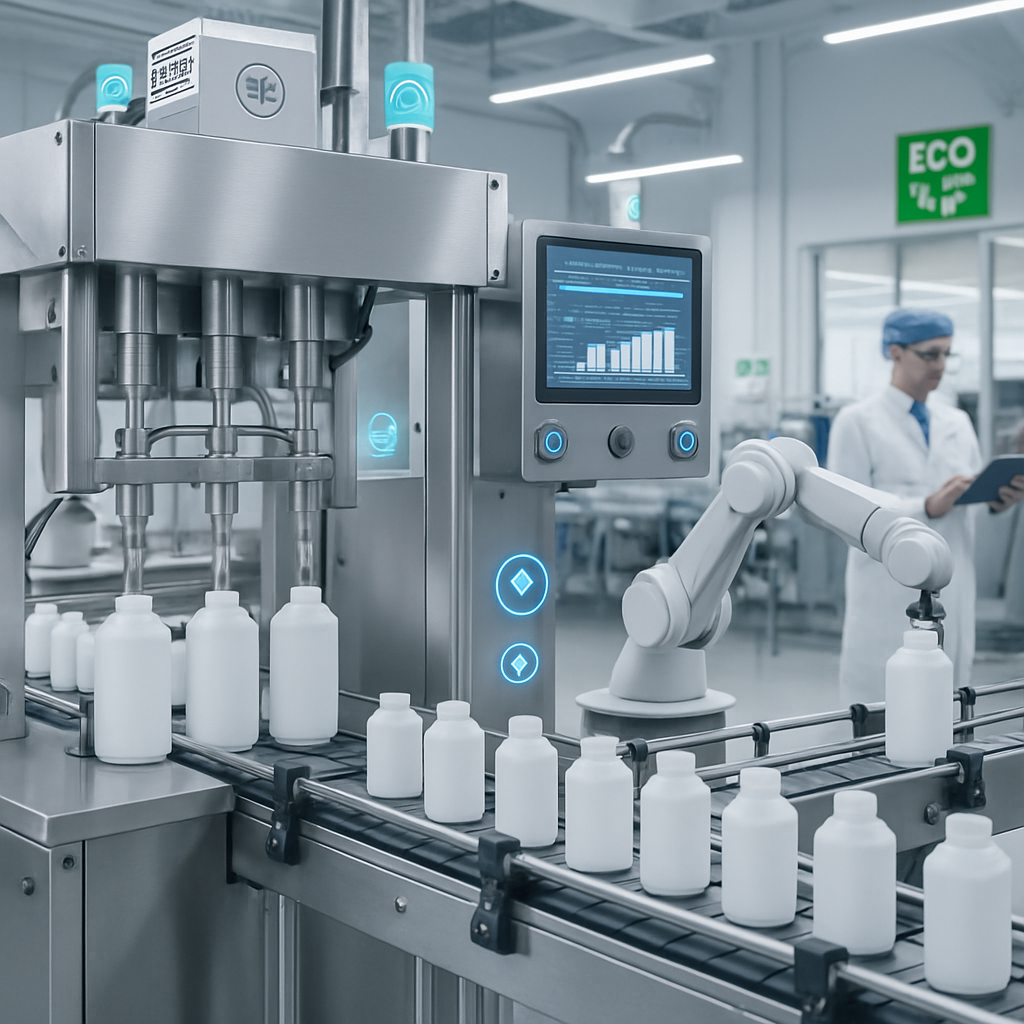
In the fast‑evolving world of liquid packaging, a “good” filling line today may not be enough tomorrow. With rising demands for flexibility, precision, sustainability, and smart connectivity, manufacturers and brand owners are asking: Is our filling line future‑proof? At Apex Filling Systems, we believe the answer depends on embracing the right emerging technologies now—so your operation remains competitive, adaptable, and efficient for years to come.
Why “Future‑Proofing” Matters
The packaging and filling industry is under pressure from multiple fronts: consumer preferences shifting towards personalized and small‑batch offerings, regulatory requirements tightening on traceability and sustainability, and workforce dynamics changing toward automation and remote capabilities. According to industry sources, these pressures are driving filling equipment to transition from stand‑alone machines to connected, modular systems. For manufacturers, this means that replacing or retrofitting a filling line every few years is no longer an option—choosing equipment that can evolve is essential.
Key Emerging Technologies That Mark a Future‑Ready Filling Line
1. Smart Connectivity & IoT Integration
Modern filling machines are increasingly equipped with sensors, controllers, and connectivity modules that collect and transmit data in real time. These systems allow you to monitor fill accuracy, cycle times, waste levels, and maintenance needs remotely. As one industry overview puts it: “IoT connectivity will let these machines communicate with others in a facility, creating more cohesive and flexible workplaces.”
Why it matters: You gain visibility into your production, can implement predictive maintenance, and reduce reactive downtime.
2. Modular, Scalable Machine Designs
Rather than rigid production lines, future‑proof systems emphasize modularity—allowing you to adjust, expand, or replace units as your volume or product needs change. According to industry commentary: “Modular filling lines provide a versatile solution … allowing for easy customization and scalability to accommodate evolving production requirements.”
Why it matters: You avoid major capital investments when you pivot products, SKUs, or target markets.
3. Enhanced Automation & Machine Learning
Adding advanced automation—robotic handlers, AI‑based recipe selection, and self‑tuning equipment—pushes your line from “automated” to “intelligent.” One paper on smart manufacturing highlights how AI and IoT enable equipment to perceive, adapt, and optimize over time.
Why it matters: Production becomes smarter, faster, and less reliant on manual interventions, freeing your team for higher‑value tasks.
4. Sustainability & Low‑Waste Operation
Sustainability isn't a trend—it’s a standard. Emerging technologies in filling machines focus on minimizing waste, using energy efficiently, and enabling eco‑friendly modes of production. For example, precision filling, closed‑loop recirculation, and servo‑driven systems all support this objective.
Why it matters: You meet regulatory and consumer demands while reducing cost and environmental impact.
5. Flexibility for Small Batch & Multi‑SKU Runs
Today’s packaging demands flexibility: rapid changeovers, multiple container formats, varied viscosities. Future‑ready lines incorporate technologies making this possible—quick changeovers, digital recipe libraries, and adaptable nozzles or modules. One analysis emphasizes that “facilities now want machines that can adapt to varying production levels to account for unexpected demand shifts.”
Why it matters: You can respond rapidly to market trends, product launches, or contract packaging demands.
Assessing Your Current Filling Line: Is It Ready?
Here are some questions to help you evaluate whether your current line is futureable or due for an upgrade:
-
Does your equipment provide real‑time data and remote access?
-
Can you monitor and adjust performance parameters from anywhere?
-
Is your line modular and upgrade‑friendly, or rigid and fixed?
-
How long does a changeover from one SKU to another take?
-
Are you seeing high waste, overfills, or manual interventions?
-
Does your line comply with emerging regulatory or sustainability standards?
If you answer “no” to multiple of these, you may be operating a filling line at risk of becoming obsolete.
How Apex Filling Systems Can Help You Future‑Proof Your Line
At Apex, future‑proofing isn’t just a marketing phrase—it’s how we design systems. Our solutions are built with:
-
Smart sensors and connectivity ready for IoT integration
-
Modular designs that expand or adapt as your business grows
-
Precision controls for minimal waste and sustainable operation
-
Rapid changeover capabilities for multi‑SKU flexibility
-
Support and consulting to upgrade legacy lines and integrate new technologies
Whether you need a semi‑automatic starter line or a fully automated multi‑head system integrated into your MES/ERP ecosystem, we’ll work with you to build a filling line that’s ready for tomorrow.
Ready to take the next step?
If your filling line isn’t keeping up with today’s demands—and can’t easily evolve—let’s talk. Contact Apex Filling Systems for a consultation and roadmap to a future‑proof production line.
Share this
- Help First (97)
- Apex Filling Systems (78)
- Filling Equipment (76)
- Informational (70)
- Automatic Filling Machine (59)
- Industry Insights (59)
- Packaging Equipment (47)
- About Apex (20)
- American Made Goods (20)
- Fillers (18)
- Automatic Capping (11)
- Apex Filling (10)
- Apex (7)
- Uncategorized (5)
- Apex Team (3)
- Apex Family (2)
- Absolute Truth (1)
- Apex Way (1)
- Petroleum (1)
- oil (1)
- August 2026 (1)
- July 2026 (5)
- June 2026 (4)
- May 2026 (5)
- April 2026 (4)
- March 2026 (4)
- February 2026 (1)
- January 2026 (2)
- December 2025 (4)
- November 2025 (4)
- October 2025 (5)
- September 2025 (3)
- June 2025 (3)
- May 2025 (6)
- April 2025 (10)
- March 2025 (10)
- February 2025 (12)
- January 2025 (14)
- December 2024 (1)
- November 2024 (4)
- October 2024 (4)
- September 2024 (2)
- August 2024 (1)
- July 2024 (4)
- October 2022 (1)
- September 2022 (1)
- June 2022 (1)
- October 2021 (2)
- June 2021 (1)
- May 2021 (1)
- April 2021 (2)
- March 2021 (2)
- February 2021 (1)
- January 2021 (2)
- November 2020 (1)
- October 2020 (1)
- September 2020 (2)
- August 2020 (1)
- July 2020 (1)
- June 2020 (1)
- May 2020 (1)
- April 2020 (2)
- March 2020 (2)
- February 2020 (2)
- January 2020 (3)
- December 2019 (2)
- November 2019 (6)
- October 2019 (4)
- September 2019 (3)
- August 2019 (6)
- July 2019 (2)
- April 2019 (1)
- February 2019 (1)
- January 2019 (7)
- December 2018 (6)
- November 2018 (5)
- October 2018 (2)
- September 2018 (2)
- August 2018 (1)
- July 2018 (3)
- May 2018 (2)
- April 2018 (1)
- March 2018 (2)
- February 2018 (2)
- January 2018 (2)