
Share this
Meeting FDA Standards with Pharmaceutical and Nutraceutical Fillers
by APEX Filling Systems on Mar 13, 2026
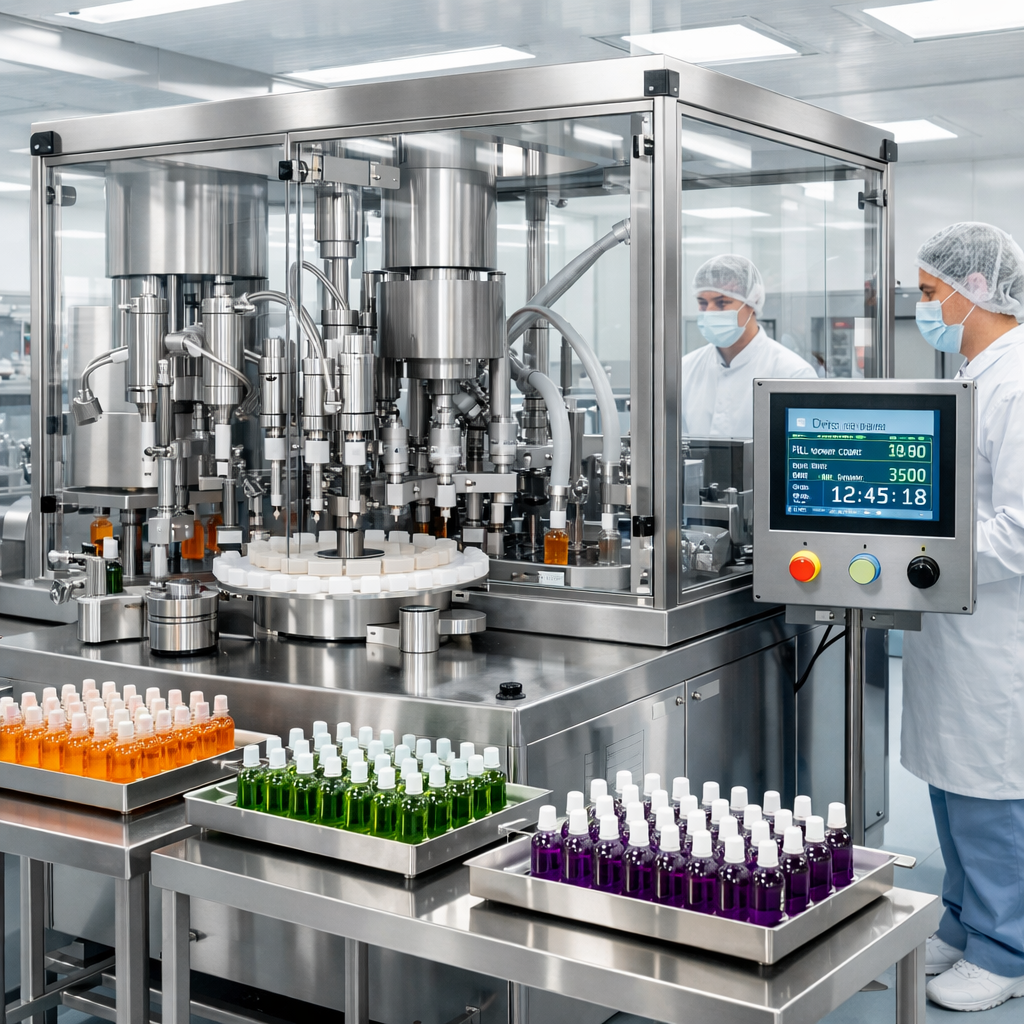
In pharmaceutical and nutraceutical manufacturing, precision, cleanliness, and regulatory compliance are non-negotiable. Products ranging from liquid vitamins and herbal extracts to prescription medications must be filled and packaged in ways that ensure safety, consistency, and traceability. For manufacturers in these industries, selecting the right filling equipment is not just about production efficiency—it’s about meeting strict FDA requirements while maintaining product integrity.
Understanding how filling technology aligns with FDA standards is essential for any company producing regulated liquid products.
Why FDA Compliance Matters in Liquid Filling
The U.S. Food and Drug Administration (FDA) regulates pharmaceutical and nutraceutical products to protect consumers and ensure product safety. Manufacturers must comply with Current Good Manufacturing Practices (cGMP), which govern how products are manufactured, processed, packaged, and stored.
For liquid filling operations, FDA compliance focuses on several critical areas:
- Sanitary equipment design
- Accurate dosing and fill consistency
- Product traceability and documentation
- Contamination prevention
- Validated cleaning and maintenance procedures
Filling equipment must support these requirements while operating reliably in high-demand production environments.
Key FDA Requirements for Liquid Filling Equipment
1. Hygienic Equipment Design
FDA-compliant filling machines must be designed to prevent contamination and allow thorough cleaning.
Important design features include:
- 316L stainless steel product contact surfaces
- Sanitary welds and polished finishes
- Minimal crevices where bacteria could accumulate
- FDA-approved seals and gaskets
- Easy disassembly for cleaning and inspection
These features ensure the equipment can be properly sanitized between batches and maintained in a sterile environment.
2. Accurate and Repeatable Fill Volumes
Pharmaceutical and nutraceutical products require extremely precise dosing. Even small deviations can lead to compliance issues or ineffective products.
Modern filling systems achieve this through:
- Servo-driven piston fillers
- Peristaltic pump filling technology
- Volumetric control systems
- Programmable fill parameters
These systems provide consistent fill accuracy and allow manufacturers to maintain strict product specifications required by FDA regulations.
3. Clean-In-Place (CIP) and Sanitation Capabilities
Cleaning procedures must be validated and documented in regulated production environments. Many pharmaceutical and nutraceutical facilities rely on Clean-In-Place (CIP) systems to maintain hygiene while minimizing downtime.
CIP-enabled filling equipment allows manufacturers to:
- Circulate cleaning solutions through product pathways
- Remove residue without dismantling the machine
- Maintain sterile production environments
- Document sanitation cycles for compliance audits
Effective cleaning procedures are a cornerstone of FDA regulatory adherence.
4. Traceability and Documentation
FDA regulations require manufacturers to maintain detailed production records for each batch. Modern filling systems can assist with compliance by providing integrated data monitoring.
Advanced equipment can track:
- Fill volumes
- Production timestamps
- Batch numbers
- Operator interactions
- System alerts or deviations
These digital records support quality assurance programs and make regulatory inspections more manageable.
5. Controlled Production Environments
Pharmaceutical and nutraceutical filling often occurs in cleanroom or controlled environments to prevent contamination.
Equipment must be compatible with these settings and designed to minimize airborne particles or contamination risks. This may include:
- Enclosed filling systems
- Laminar airflow compatibility
- Minimal vibration and particle generation
- Stainless steel frames that withstand sanitation protocols
These features ensure that the packaging process meets the stringent standards required for regulated products.
Choosing the Right Filling Technology
Several filling technologies are commonly used in pharmaceutical and nutraceutical applications:
Peristaltic Fillers
Peristaltic pumps move liquid through sterile tubing, preventing direct contact between the product and mechanical components. This design supports sterile filling and reduces cross-contamination risks.
Servo-Driven Piston Fillers
Servo-driven piston systems provide exceptional volumetric accuracy and repeatability. They are ideal for thicker nutraceutical products such as syrups, suspensions, and herbal extracts.
Gravity or Overflow Fillers
These fillers are sometimes used for low-viscosity liquids where visual fill level consistency is important.
The right choice depends on factors such as product viscosity, sterility requirements, container size, and production volume.
The Role of Automation in Compliance
Automation is increasingly helping pharmaceutical and nutraceutical manufacturers maintain compliance while improving efficiency.
Automated filling lines can integrate:
- Capping machines
- Labeling systems
- Inspection equipment
- Reject systems
This integration reduces manual handling, minimizes contamination risk, and ensures consistent product packaging.
Automated solutions also support better documentation and traceability, which are essential during FDA inspections.
Partnering with the Right Equipment Provider
Achieving FDA compliance is not only about selecting the right filling technology—it’s about working with equipment manufacturers who understand regulatory environments.
A knowledgeable equipment partner can help manufacturers:
- Select sanitary machine designs
- Integrate filling, capping, and labeling systems
- Implement traceability features
- Design systems compatible with cleanroom operations
- Plan scalable solutions for future production growth
The right partnership ensures that filling equipment meets both operational goals and regulatory standards.
Final Thoughts
Meeting FDA standards in pharmaceutical and nutraceutical production requires careful attention to equipment design, sanitation, accuracy, and documentation. Filling systems must deliver consistent performance while maintaining strict hygiene and traceability.
By investing in properly designed liquid filling equipment and automated packaging solutions, manufacturers can confidently meet regulatory requirements while maintaining efficient production.
In regulated industries where quality and safety are paramount, the right filling system is more than a piece of machinery—it is a critical component of compliance and consumer trust.
Share this
- Help First (97)
- Apex Filling Systems (78)
- Filling Equipment (76)
- Informational (70)
- Automatic Filling Machine (59)
- Industry Insights (59)
- Packaging Equipment (47)
- About Apex (20)
- American Made Goods (20)
- Fillers (18)
- Automatic Capping (11)
- Apex Filling (10)
- Apex (7)
- Uncategorized (5)
- Apex Team (3)
- Apex Family (2)
- Absolute Truth (1)
- Apex Way (1)
- Petroleum (1)
- oil (1)
- August 2026 (1)
- July 2026 (5)
- June 2026 (4)
- May 2026 (5)
- April 2026 (4)
- March 2026 (4)
- February 2026 (1)
- January 2026 (2)
- December 2025 (4)
- November 2025 (4)
- October 2025 (5)
- September 2025 (3)
- June 2025 (3)
- May 2025 (6)
- April 2025 (10)
- March 2025 (10)
- February 2025 (12)
- January 2025 (14)
- December 2024 (1)
- November 2024 (4)
- October 2024 (4)
- September 2024 (2)
- August 2024 (1)
- July 2024 (4)
- October 2022 (1)
- September 2022 (1)
- June 2022 (1)
- October 2021 (2)
- June 2021 (1)
- May 2021 (1)
- April 2021 (2)
- March 2021 (2)
- February 2021 (1)
- January 2021 (2)
- November 2020 (1)
- October 2020 (1)
- September 2020 (2)
- August 2020 (1)
- July 2020 (1)
- June 2020 (1)
- May 2020 (1)
- April 2020 (2)
- March 2020 (2)
- February 2020 (2)
- January 2020 (3)
- December 2019 (2)
- November 2019 (6)
- October 2019 (4)
- September 2019 (3)
- August 2019 (6)
- July 2019 (2)
- April 2019 (1)
- February 2019 (1)
- January 2019 (7)
- December 2018 (6)
- November 2018 (5)
- October 2018 (2)
- September 2018 (2)
- August 2018 (1)
- July 2018 (3)
- May 2018 (2)
- April 2018 (1)
- March 2018 (2)
- February 2018 (2)
- January 2018 (2)