
Share this
Robotics & Filling Lines: How They’re Working Together to Improve Throughput
by APEX Filling Systems on Mar 06, 2026
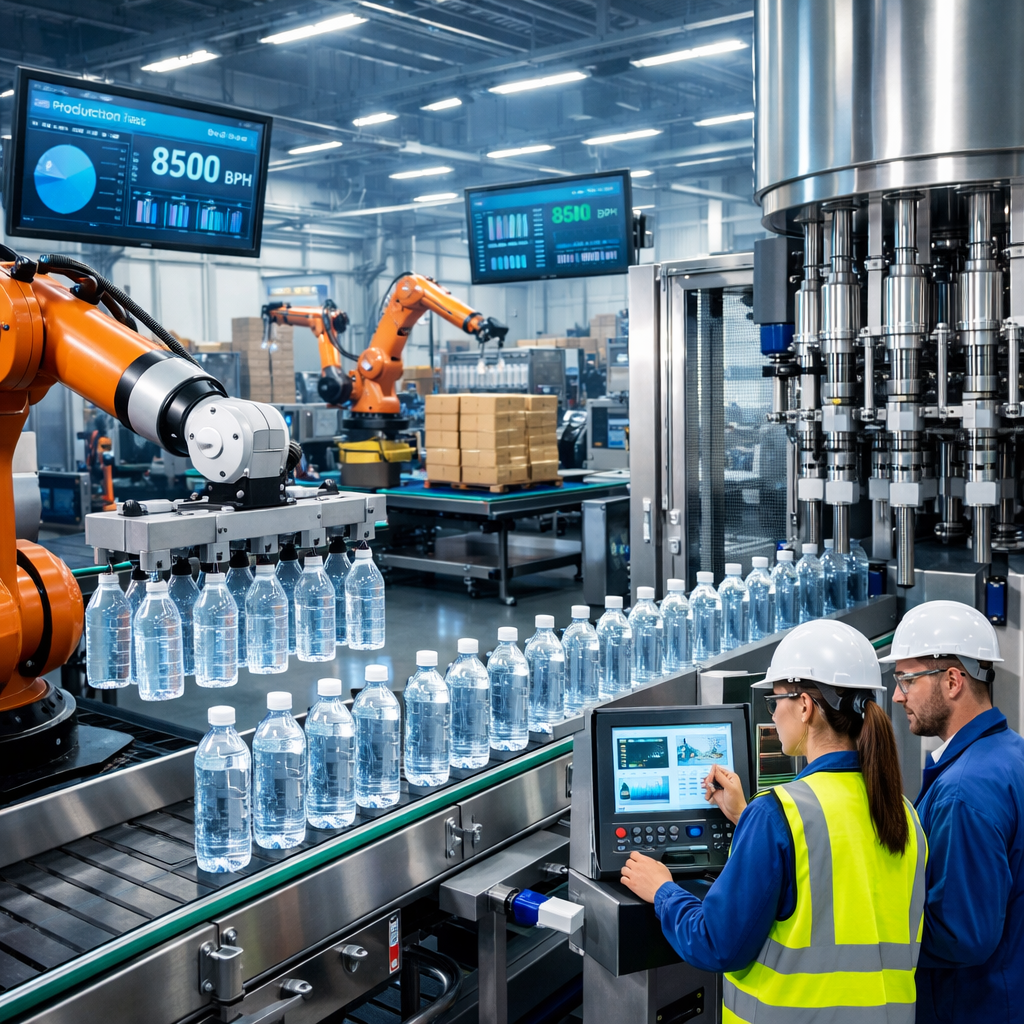
Modern manufacturing is no longer defined by speed alone. Today’s production environments demand precision, flexibility, labor efficiency, and data visibility—all while increasing throughput.
One of the most powerful advancements helping manufacturers meet these demands is the integration of robotics with liquid filling lines.
From bottle handling and cap placement to case packing and palletizing, robotics are transforming how filling systems operate. When paired with advanced filling, capping, and labeling equipment, robotic technology helps create highly efficient, scalable, and future-ready packaging lines.
Let’s explore how robotics and filling systems are working together to improve throughput across industries.
What Role Do Robotics Play in Liquid Packaging?
Robotics in liquid packaging typically support operations surrounding the filling process rather than replacing the filling machine itself.
Common robotic applications include:
- Bottle unscrambling and orientation
- Container loading and positioning
- Cap sorting and placement
- Pick-and-place labeling support
- Case packing and cartoning
- Palletizing finished goods
- Quality inspection and rejection
When integrated with high-speed inline or rotary filling machines, robotics reduce bottlenecks before and after the fill cycle—maximizing overall line performance.
Why Throughput Is About More Than Fill Speed
Many manufacturers assume throughput is determined by how fast a filler can dispense liquid.
In reality, throughput is influenced by:
- Container handling speed
- Changeover efficiency
- Cap placement accuracy
- Label alignment
- Operator intervention frequency
- Downtime caused by jams or misfeeds
Robotics help stabilize these surrounding processes, allowing the filling system to operate at its intended capacity.
The result? Higher overall line efficiency—not just faster fills.
Key Benefits of Robotics in Filling Line Operations
1. Reduced Labor Dependency
Labor shortages continue to impact manufacturing facilities across North America.
Robotic integration allows manufacturers to:
- Reduce repetitive manual tasks
- Reassign employees to higher-value roles
- Minimize fatigue-related errors
- Improve workplace safety
Instead of manually loading containers or packing cases, operators can oversee performance metrics and quality control.
2. Improved Line Consistency
Human variability can impact:
- Bottle alignment
- Cap placement torque
- Carton packing uniformity
- Changeover timing
Robotics operate with programmable, repeatable motion—ensuring consistent performance shift after shift.
This consistency supports:
- Better fill accuracy
- Fewer rejected units
- Reduced product waste
- Stronger brand presentation
3. Faster Changeovers for Multi-SKU Production
Modern production environments often require frequent SKU changes.
Robotics paired with servo-driven filling systems allow:
- Recipe-based adjustments
- Automated height and position changes
- Pre-programmed container handling settings
Instead of lengthy manual adjustments, robotic systems can reconfigure quickly—keeping downtime to a minimum.
For companies running custom filling machines for food and beverage, health & beauty, or chemical products, this flexibility is critical.
4. Enhanced Workplace Safety
Packaging lines present several safety risks:
- Repetitive strain injuries
- Heavy lifting
- Fast-moving conveyors
- Exposure to hazardous or flammable liquids
Robotic palletizers and automated case packers remove employees from physically demanding or potentially dangerous tasks.
In chemical and flammable liquid environments, robotics reduce direct human interaction near volatile materials—supporting OSHA and facility safety standards.
5. Better Data Collection and Smart Factory Integration
Robotics integrated with modern filling equipment contribute to Industry 4.0 initiatives.
When connected to centralized systems, manufacturers can monitor:
- Cycle times
- Throughput rates
- Fault codes
- Rejected units
- Preventative maintenance alerts
This data enables:
- Predictive maintenance scheduling
- Bottleneck identification
- Continuous improvement planning
- More accurate production forecasting
Throughput improvements are no longer guesswork—they’re measurable and trackable.
Where Robotics Have the Biggest Impact
Robotics are especially valuable in:
High-Speed Beverage Production
Rotary filling systems paired with robotic case packers and palletizers maintain continuous flow without slowdowns.
Chemical & Industrial Packaging
Robotic handling reduces exposure to corrosive or hazardous liquids while improving container positioning accuracy.
Nutraceutical & CBD Bottling
Robotic pick-and-place systems ensure precise bottle alignment before filling and accurate labeling afterward.
Food & Sauce Production
Chunky or viscous products often require stable container positioning—robotics help prevent spills and misalignment.
Inline vs. Rotary Filling Lines with Robotics
Both system types benefit from robotic integration:
Inline Filling Systems
Robotics improve container feeding and end-of-line packaging, supporting scalable operations and moderate-to-high throughput environments.
Rotary Filling Systems
High-speed rotary platforms benefit from robotic palletizing and automated downstream handling to prevent output congestion.
Selecting the right configuration depends on:
- Required production volume
- Container types
- Product viscosity
- Available floor space
- Long-term growth projections
Frequently Asked Questions
Do robots replace filling machines?
No. Robotics support and enhance filling line performance. The filling machine remains the core dispensing system.
Can robotics increase production speed?
Yes, by eliminating bottlenecks before and after the fill cycle, robotics improve overall throughput.
Are robotic systems only for large manufacturers?
Not necessarily. Modular robotic solutions are scalable and can be integrated gradually as production grows.
Do robotics reduce maintenance?
Robotics reduce wear caused by manual misalignment and repetitive strain but still require scheduled preventative maintenance.
Are robotics compatible with servo-driven filling systems?
Absolutely. Servo-driven fillers and robotics complement each other within automated packaging line solutions.
Is Robotics Integration Right for Your Operation?
Robotics may be a strong investment if:
- You experience labor shortages
- Your line frequently backs up after filling
- Changeovers consume excessive time
- You are scaling production
- Safety concerns exist in hazardous environments
- You are pursuing smart factory initiatives
For smaller operations, robotics can be implemented in phases—starting with palletizing or case packing before expanding upstream.
Final Thoughts: Throughput Is a System, Not a Speed Setting
Throughput improvement isn’t just about installing a faster filling machine. It’s about optimizing the entire packaging ecosystem.
When robotics and modern filling lines work together, manufacturers gain:
- Greater production stability
- Reduced labor strain
- Improved safety
- Higher output consistency
- Scalable automation infrastructure
The future of liquid packaging is collaborative—where precision filling systems, intelligent robotics, and real-time data work in sync.
Ready to Improve Your Throughput?
If you're evaluating high-speed filling systems, automated capping and labeling equipment, or robotic integration for your packaging line, our team can help design a solution tailored to your production goals.
Contact Apex Filling Systems today to explore how robotics and filling technology can work together for your operation.
Share this
- Help First (97)
- Apex Filling Systems (78)
- Filling Equipment (76)
- Informational (70)
- Automatic Filling Machine (59)
- Industry Insights (59)
- Packaging Equipment (47)
- About Apex (20)
- American Made Goods (20)
- Fillers (18)
- Automatic Capping (11)
- Apex Filling (10)
- Apex (7)
- Uncategorized (5)
- Apex Team (3)
- Apex Family (2)
- Absolute Truth (1)
- Apex Way (1)
- Petroleum (1)
- oil (1)
- August 2026 (1)
- July 2026 (5)
- June 2026 (4)
- May 2026 (5)
- April 2026 (4)
- March 2026 (4)
- February 2026 (1)
- January 2026 (2)
- December 2025 (4)
- November 2025 (4)
- October 2025 (5)
- September 2025 (3)
- June 2025 (3)
- May 2025 (6)
- April 2025 (10)
- March 2025 (10)
- February 2025 (12)
- January 2025 (14)
- December 2024 (1)
- November 2024 (4)
- October 2024 (4)
- September 2024 (2)
- August 2024 (1)
- July 2024 (4)
- October 2022 (1)
- September 2022 (1)
- June 2022 (1)
- October 2021 (2)
- June 2021 (1)
- May 2021 (1)
- April 2021 (2)
- March 2021 (2)
- February 2021 (1)
- January 2021 (2)
- November 2020 (1)
- October 2020 (1)
- September 2020 (2)
- August 2020 (1)
- July 2020 (1)
- June 2020 (1)
- May 2020 (1)
- April 2020 (2)
- March 2020 (2)
- February 2020 (2)
- January 2020 (3)
- December 2019 (2)
- November 2019 (6)
- October 2019 (4)
- September 2019 (3)
- August 2019 (6)
- July 2019 (2)
- April 2019 (1)
- February 2019 (1)
- January 2019 (7)
- December 2018 (6)
- November 2018 (5)
- October 2018 (2)
- September 2018 (2)
- August 2018 (1)
- July 2018 (3)
- May 2018 (2)
- April 2018 (1)
- March 2018 (2)
- February 2018 (2)
- January 2018 (2)