
Share this
The Role of Visual Dashboards in Operator Efficiency
by APEX Filling Systems on Mar 27, 2026
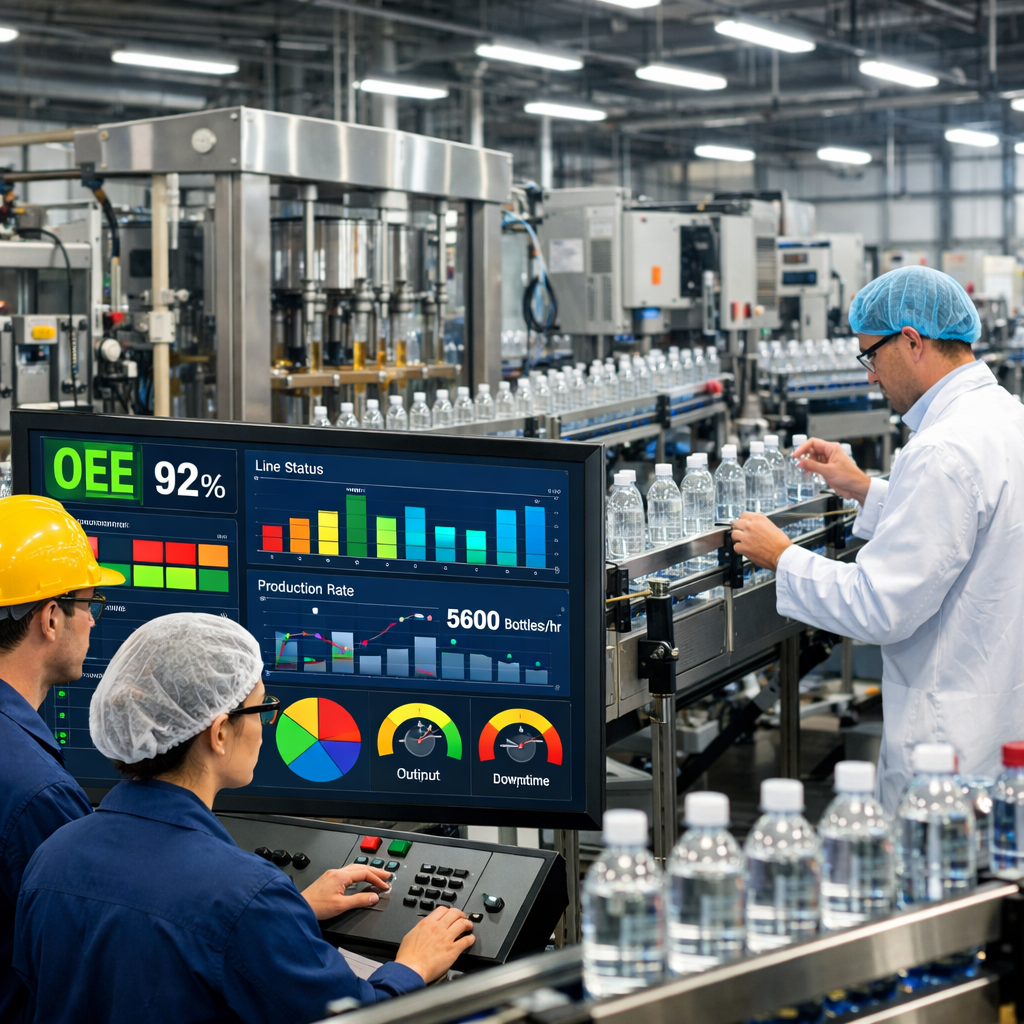
In today’s fast-paced manufacturing environment, efficiency is no longer driven by machinery alone—it’s driven by how well operators can interact with, understand, and respond to real-time production data. As liquid packaging lines become more advanced, visual dashboards have emerged as a critical tool for improving operator performance, reducing downtime, and increasing overall throughput.
From filling and capping to labeling and quality control, visual dashboards are transforming how operators manage production lines—turning complex data into clear, actionable insights.
What Is a Visual Dashboard in Manufacturing?
A visual dashboard is a digital interface—typically displayed on an HMI (Human Machine Interface) or external screen—that presents real-time production data in a clear, easy-to-understand format.
These dashboards can display:
- Fill volumes and accuracy metrics
- Machine status (running, idle, fault)
- Production rates and output counts
- Changeover settings and recipes
- Maintenance alerts and diagnostics
- Line efficiency (OEE) data
Rather than requiring operators to interpret raw data or complex controls, dashboards simplify information into visual cues such as graphs, color indicators, and alerts.
Why Visual Dashboards Matter for Operator Efficiency
1. Faster Decision-Making
In a production environment, delays in decision-making can lead to lost output, wasted product, or extended downtime.
Visual dashboards enable operators to:
- Instantly identify issues
- Monitor performance trends
- Adjust machine settings quickly
For example, if a dashboard shows a drop in fill accuracy or a slowdown in throughput, operators can immediately take corrective action—without waiting for manual reports or supervisor input.
2. Reduced Training Time for New Operators
Training new operators on complex filling equipment can be time-consuming. Traditional systems often require extensive technical knowledge to interpret machine data.
Visual dashboards simplify this process by:
- Using intuitive icons and color-coded indicators
- Providing step-by-step prompts for operation
- Displaying clear alerts and troubleshooting guidance
This makes it easier for new team members to become productive quickly, reducing onboarding time and improving workforce flexibility.
3. Improved Line Visibility Across Equipment
Modern packaging lines consist of multiple integrated systems, including:
- Filling machines
- Capping equipment
- Labeling systems
- Conveyors and accumulation tables
Visual dashboards can provide a centralized view of the entire line, allowing operators to see how each component is performing in real time.
This holistic visibility helps identify bottlenecks, such as:
- Backup at the capping station
- Label misalignment issues
- Inconsistent bottle flow
By seeing the full picture, operators can proactively manage the line rather than reacting to isolated issues.
4. Enhanced Accuracy and Reduced Errors
Manual adjustments and guesswork can lead to inconsistent results.
Visual dashboards reduce human error by:
- Displaying exact fill setpoints
- Showing real-time deviation from targets
- Providing alerts when parameters fall outside acceptable ranges
This ensures operators maintain consistent production standards—especially critical in industries such as food, beverage, chemical, and nutraceutical manufacturing.
5. Real-Time Alerts and Preventative Action
Downtime is one of the biggest threats to production efficiency.
Visual dashboards provide real-time alerts for:
- Equipment faults
- Low product levels
- Maintenance requirements
- Conveyor jams or misfeeds
Instead of discovering issues after they escalate, operators can respond immediately—often preventing minor issues from becoming major disruptions.
The Impact on Throughput and Productivity
When operators have access to clear, real-time data, the entire production line becomes more efficient.
Benefits include:
- Faster response times to issues
- Reduced unplanned downtime
- Improved fill accuracy and consistency
- Smoother changeovers between products
- Increased overall equipment effectiveness (OEE)
In high-speed filling environments, even small improvements in response time can translate into significant gains in daily output.
Visual Dashboards and Smart Manufacturing
Visual dashboards are a key component of Industry 4.0 and smart factory initiatives.
When integrated with connected systems, dashboards can pull data from:
- Filling machines
- Capping and labeling equipment
- Sensors and inspection systems
- ERP and production planning software
This allows manufacturers to not only monitor performance in real time but also analyze trends over time.
Advanced dashboards can support:
- Predictive maintenance
- Performance benchmarking
- Production forecasting
- Continuous improvement initiatives
Designing an Effective Dashboard
Not all dashboards are equally effective. The best systems are designed with the operator in mind.
Key elements of an effective visual dashboard include:
- Clarity: Information is easy to read and understand at a glance
- Relevance: Only critical data is displayed to avoid overload
- Color Coding: Clear visual cues for normal operation vs. issues
- Customization: Ability to tailor views based on operator roles
- Responsiveness: Real-time updates with minimal delay
A well-designed dashboard should empower operators—not overwhelm them.
Integration with Filling, Capping, and Labeling Systems
In liquid packaging operations, visual dashboards are most effective when integrated across the entire line.
This includes:
- Monitoring fill levels and accuracy
- Tracking cap application and torque consistency
- Verifying label placement and alignment
- Coordinating conveyor speeds
By connecting all components, operators gain full control over the packaging process—ensuring consistency from start to finish.
Is Your Operation Ready for Visual Dashboards?
Visual dashboards are especially valuable for manufacturers who:
- Operate multi-machine packaging lines
- Experience frequent downtime or bottlenecks
- Train new operators regularly
- Manage multiple SKUs or product changes
- Are implementing automation or smart factory initiatives
Even for smaller operations, upgrading to a system with clear visual controls can significantly improve day-to-day efficiency.
Final Thoughts
In modern manufacturing, data is only valuable if it can be understood and acted upon quickly. Visual dashboards bridge the gap between complex machine data and real-world operator decisions.
By improving visibility, reducing errors, and enabling faster response times, dashboards play a critical role in optimizing filling line performance.
As liquid packaging systems continue to evolve, visual dashboards will remain a key driver of efficiency—helping operators work smarter, not harder.
Ready to Improve Operator Efficiency?
If you’re looking to enhance your filling, capping, and labeling operations with user-friendly interfaces and real-time data visibility, our team can help design a solution tailored to your needs.
Contact Apex Filling Systems today to learn more about smart, operator-focused packaging solutions.
Share this
- Help First (97)
- Apex Filling Systems (78)
- Filling Equipment (76)
- Informational (70)
- Automatic Filling Machine (59)
- Industry Insights (59)
- Packaging Equipment (47)
- About Apex (20)
- American Made Goods (20)
- Fillers (18)
- Automatic Capping (11)
- Apex Filling (10)
- Apex (7)
- Uncategorized (5)
- Apex Team (3)
- Apex Family (2)
- Absolute Truth (1)
- Apex Way (1)
- Petroleum (1)
- oil (1)
- August 2026 (1)
- July 2026 (5)
- June 2026 (4)
- May 2026 (5)
- April 2026 (4)
- March 2026 (4)
- February 2026 (1)
- January 2026 (2)
- December 2025 (4)
- November 2025 (4)
- October 2025 (5)
- September 2025 (3)
- June 2025 (3)
- May 2025 (6)
- April 2025 (10)
- March 2025 (10)
- February 2025 (12)
- January 2025 (14)
- December 2024 (1)
- November 2024 (4)
- October 2024 (4)
- September 2024 (2)
- August 2024 (1)
- July 2024 (4)
- October 2022 (1)
- September 2022 (1)
- June 2022 (1)
- October 2021 (2)
- June 2021 (1)
- May 2021 (1)
- April 2021 (2)
- March 2021 (2)
- February 2021 (1)
- January 2021 (2)
- November 2020 (1)
- October 2020 (1)
- September 2020 (2)
- August 2020 (1)
- July 2020 (1)
- June 2020 (1)
- May 2020 (1)
- April 2020 (2)
- March 2020 (2)
- February 2020 (2)
- January 2020 (3)
- December 2019 (2)
- November 2019 (6)
- October 2019 (4)
- September 2019 (3)
- August 2019 (6)
- July 2019 (2)
- April 2019 (1)
- February 2019 (1)
- January 2019 (7)
- December 2018 (6)
- November 2018 (5)
- October 2018 (2)
- September 2018 (2)
- August 2018 (1)
- July 2018 (3)
- May 2018 (2)
- April 2018 (1)
- March 2018 (2)
- February 2018 (2)
- January 2018 (2)