
Share this
Everything Manufacturers Need to Know About Filling DEF
by APEX Filling Systems on Jul 03, 2026
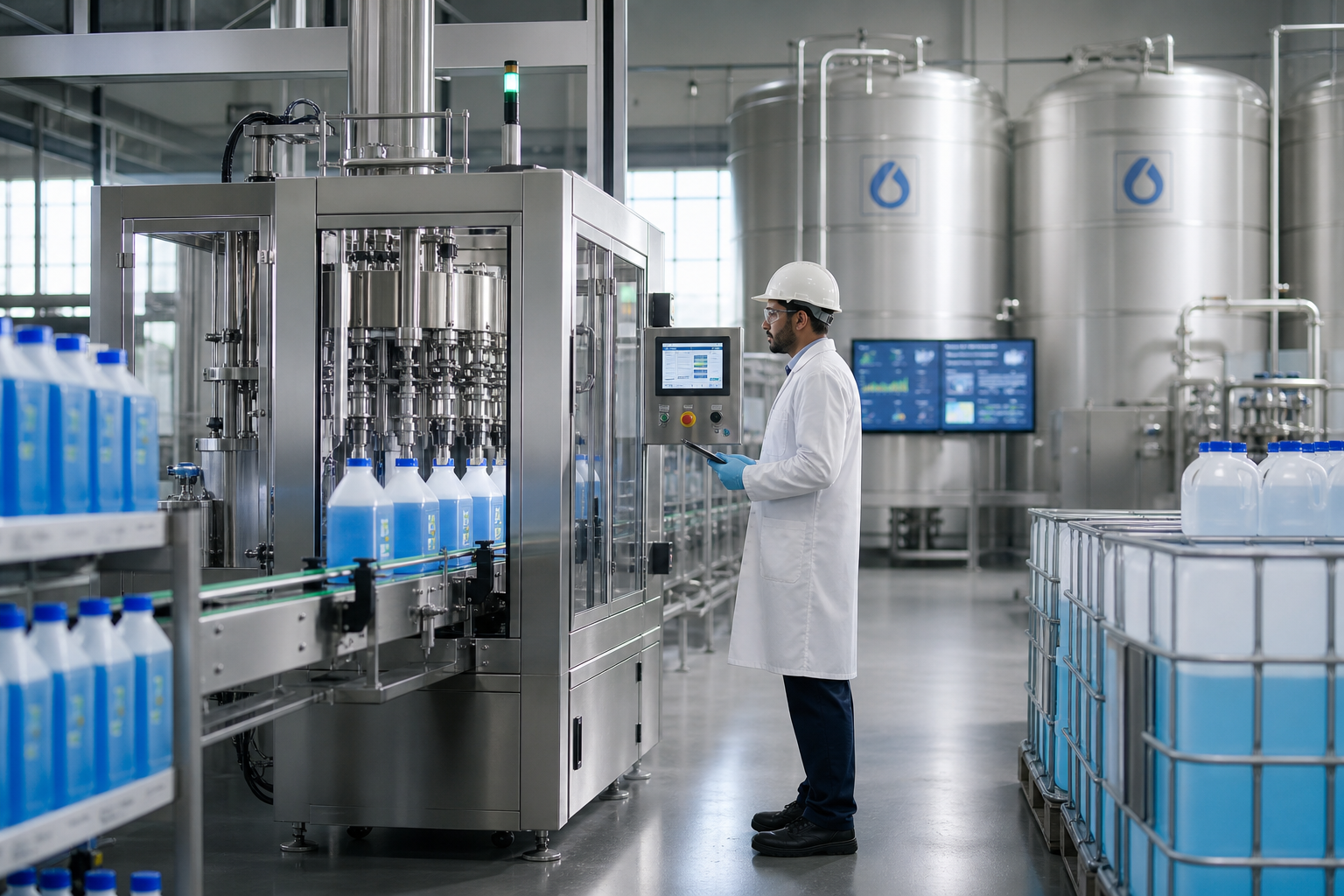
At Apex Filling Systems, We Know DEF Packaging
At Apex Filling Systems, we help manufacturers package Diesel Exhaust Fluid (DEF), chemicals, lubricants, automotive fluids, and other industrial liquids with precision and confidence. When selecting filling equipment for DEF, protecting product purity is just as important as achieving accurate fill volumes and efficient production.
Because DEF is manufactured to strict quality standards, choosing the right filling equipment—and the right materials of construction—is essential. From storage tanks and transfer lines to filling nozzles and capping systems, every component that contacts the product plays a role in maintaining quality and ensuring customer satisfaction.
What Equipment Is Required to Properly Fill Diesel Exhaust Fluid (DEF)?
Packaging Diesel Exhaust Fluid requires filling equipment specifically designed to protect product purity and comply with ISO 22241 standards. Manufacturers should use compatible product-contact materials such as stainless steel and approved plastics, maintain dedicated product pathways to prevent contamination, and utilize accurate filling technology capable of consistently dispensing DEF into bottles, jugs, drums, totes, or bulk containers.
Beyond the filling machine itself, successful DEF packaging also depends on proper storage, clean transfer systems, automated capping, accurate labeling, and quality control processes that preserve the integrity of the product throughout production.
Why DEF Requires Specialized Filling Equipment
Diesel Exhaust Fluid is a simple product in composition but demanding in application.
DEF consists of:
- 32.5% high-purity automotive-grade urea
- 67.5% deionized water
It is used in Selective Catalytic Reduction (SCR) systems to reduce nitrogen oxide (NOx) emissions from diesel engines.
Although DEF is not hazardous or flammable, it is extremely sensitive to contamination. Even small amounts of incompatible metals, minerals, lubricants, or other foreign materials can reduce product quality and potentially damage SCR systems.
That is why packaging equipment must be designed specifically with DEF applications in mind.
ISO 22241: The Standard Every DEF Manufacturer Should Understand
DEF quality is governed by ISO 22241, the international standard that establishes requirements for:
Product purity
Ensuring the correct concentration of urea and deionized water while minimizing contaminants.
Storage and handling
Protecting DEF from contamination throughout production and packaging.
Equipment compatibility
Using approved materials throughout the product-contact path.
Following ISO 22241 helps manufacturers deliver consistent, high-quality DEF while protecting customers' emissions systems.
Choosing the Right Materials for DEF Packaging
Material compatibility is one of the most important aspects of a DEF filling line.
Recommended product-contact materials include:
- 304 stainless steel
- 316 stainless steel
- High-density polyethylene (HDPE)
- Polypropylene (PP)
- Compatible seals and elastomers designed for DEF
The Apex Filling Systems team frequently works with manufacturers to ensure every product-contact component is compatible with DEF, reducing the risk of contamination and extending equipment life.
Preventing Contamination Throughout Production
Contamination remains the leading cause of DEF quality issues.
Common contamination sources include:
- Non-dedicated transfer hoses
- Residual chemicals from previous production
- Oils and lubricants
- Metal particles
- Dust and debris
- Improper cleaning procedures
Many manufacturers choose dedicated DEF packaging equipment to eliminate cross-contamination risks and maintain product consistency.
Selecting the Right Filling Technology
The ideal filling technology depends on production speed, container size, and packaging requirements.
Common options include:
Flow Meter Filling
Provides highly accurate volumetric fills and is well suited for DEF applications where precision and repeatability are critical.
Timed Flow Filling
Offers reliable performance for many production environments with relatively low-viscosity products like DEF.
Gravity Filling
Can be appropriate for certain applications depending on production requirements and container configuration.
Apex Filling Systems evaluates each customer's production goals, container types, and throughput requirements to recommend the most effective filling solution.
Container Types and Packaging Flexibility
DEF is commonly packaged in:
- Retail bottles
- One-gallon jugs
- 2.5-gallon containers
- Five-gallon containers
- 55-gallon drums
- IBC totes
- Bulk filling systems
Modern filling equipment should accommodate multiple container sizes while allowing for efficient product changeovers and future expansion.
Capping and Labeling Considerations
Once containers are filled, they must be sealed and labeled accurately.
Automated capping systems help ensure:
- Proper torque
- Leak prevention
- Tamper evidence
- Consistent sealing
Likewise, integrated labeling systems improve efficiency while supporting:
- Product identification
- Batch traceability
- Manufacturing dates
- Regulatory information
A fully integrated filling, capping, and labeling line reduces manual handling and helps maintain product integrity.
Automation Improves Quality and Efficiency
Today's DEF packaging lines increasingly incorporate automation to improve consistency and reduce operator intervention.
Benefits include:
- Higher throughput
- More consistent fill accuracy
- Reduced contamination risk
- Lower labor requirements
- Improved traceability
Many modern systems also feature real-time dashboards that monitor production rates, fill accuracy, downtime, and maintenance needs.
Common Mistakes to Avoid When Packaging DEF
Manufacturers new to DEF packaging often encounter preventable issues.
Common mistakes include:
Using incompatible materials
Certain metals and components can contaminate DEF.
Sharing equipment with other chemicals
Cross-contamination can quickly compromise product quality.
Ignoring cleaning procedures
Proper sanitation is essential for maintaining purity.
Overlooking fill accuracy
Even small overfills increase product giveaway and operating costs.
Failing to plan for future growth
Selecting scalable equipment allows manufacturers to expand production without replacing an entire line.
What Information Should You Gather Before Speaking with Apex?
If you're planning a new DEF packaging line or upgrading an existing one, gathering the following information will help the Apex team recommend the right solution:
- Container sizes and styles
- Desired fill volumes
- Required production speed (containers per minute or hour)
- Container material (HDPE, PET, etc.)
- Closure type
- Desired level of automation
- Available production space
- Current packaging challenges
- Future production growth plans
Having this information available helps streamline the equipment selection process and ensures your system is designed around your specific application.
Frequently Asked Questions
What type of filling machine is best for Diesel Exhaust Fluid?
Flow meter filling systems are commonly used because they provide excellent accuracy and repeatability. The best solution depends on your production speed, container size, and automation requirements.
Does DEF require stainless steel equipment?
Many DEF applications utilize 304 or 316 stainless steel for product-contact components because these materials help maintain product purity and comply with ISO 22241 recommendations.
Can the same filling line package DEF and other chemicals?
It is generally recommended to use dedicated equipment for DEF whenever possible to minimize the risk of cross-contamination.
What container sizes can DEF be packaged in?
DEF is commonly packaged in retail bottles, one-gallon jugs, five-gallon containers, drums, IBC totes, and bulk systems.
Is DEF difficult to package?
Not when the proper equipment and procedures are used. With compatible materials, accurate filling technology, and dedicated production practices, manufacturers can package DEF efficiently while maintaining strict quality standards.
Ready to Find the Right DEF Filling Solution?
Not sure which equipment is right for your application?
Use the Apex Equipment Fit Selector to answer a few questions about your product, containers, and production goals. An Apex team member can review your information and help identify the best solution for your operation.
About Apex Filling Systems
Apex Filling Systems designs and manufactures liquid filling, capping, labeling, and conveying equipment for manufacturers across the food, beverage, chemical, personal care, DEF, and distilled spirits industries. Every packaging application is unique, and our team works closely with customers to recommend equipment that fits their products, production goals, and future growth plans.
Continue Exploring
Equipment Solutions
Explore Apex equipment designed for accurate, contamination-free DEF packaging:
Helpful Tools
Planning a new DEF packaging line or upgrading an existing one?
Related Articles
Continue learning about Diesel Exhaust Fluid packaging and equipment selection:
Share this
- Help First (97)
- Apex Filling Systems (78)
- Filling Equipment (76)
- Informational (70)
- Automatic Filling Machine (59)
- Industry Insights (59)
- Packaging Equipment (47)
- About Apex (20)
- American Made Goods (20)
- Fillers (18)
- Automatic Capping (11)
- Apex Filling (10)
- Apex (7)
- Uncategorized (5)
- Apex Team (3)
- Apex Family (2)
- Absolute Truth (1)
- Apex Way (1)
- Petroleum (1)
- oil (1)
- August 2026 (1)
- July 2026 (5)
- June 2026 (4)
- May 2026 (5)
- April 2026 (4)
- March 2026 (4)
- February 2026 (1)
- January 2026 (2)
- December 2025 (4)
- November 2025 (4)
- October 2025 (5)
- September 2025 (3)
- June 2025 (3)
- May 2025 (6)
- April 2025 (10)
- March 2025 (10)
- February 2025 (12)
- January 2025 (14)
- December 2024 (1)
- November 2024 (4)
- October 2024 (4)
- September 2024 (2)
- August 2024 (1)
- July 2024 (4)
- October 2022 (1)
- September 2022 (1)
- June 2022 (1)
- October 2021 (2)
- June 2021 (1)
- May 2021 (1)
- April 2021 (2)
- March 2021 (2)
- February 2021 (1)
- January 2021 (2)
- November 2020 (1)
- October 2020 (1)
- September 2020 (2)
- August 2020 (1)
- July 2020 (1)
- June 2020 (1)
- May 2020 (1)
- April 2020 (2)
- March 2020 (2)
- February 2020 (2)
- January 2020 (3)
- December 2019 (2)
- November 2019 (6)
- October 2019 (4)
- September 2019 (3)
- August 2019 (6)
- July 2019 (2)
- April 2019 (1)
- February 2019 (1)
- January 2019 (7)
- December 2018 (6)
- November 2018 (5)
- October 2018 (2)
- September 2018 (2)
- August 2018 (1)
- July 2018 (3)
- May 2018 (2)
- April 2018 (1)
- March 2018 (2)
- February 2018 (2)
- January 2018 (2)