
Share this
Filling Equipment Considerations for Chemical Manufacturers in 2026
by APEX Filling Systems on May 08, 2026
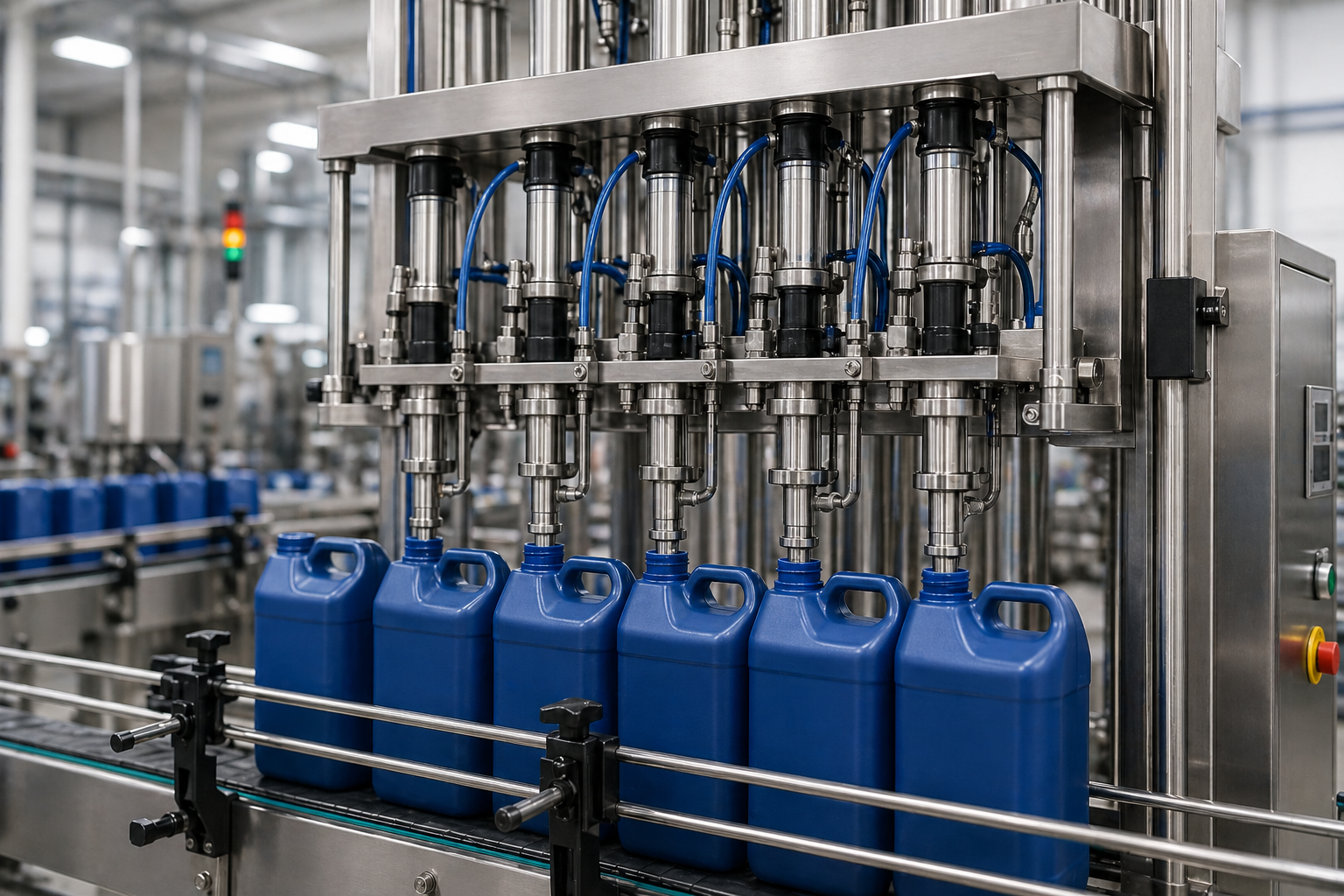
At Apex Filling Systems, We Help Chemical Manufacturers Package Products Safely and Efficiently
At Apex Filling Systems, we help chemical manufacturers package everything from industrial cleaners and solvents to corrosive chemicals, lubricants, automotive fluids, and specialty formulations. Selecting the right filling equipment for chemical applications requires more than matching a machine to a production rate—it requires understanding your product chemistry, regulatory requirements, packaging goals, and future growth plans.
Chemical products present unique challenges that demand specialized equipment. Material compatibility, workplace safety, filling accuracy, and line integration all play an important role in building a reliable, efficient packaging operation that performs for years to come.
What Should Chemical Manufacturers Consider When Choosing Filling Equipment?
Chemical manufacturers should evaluate filling equipment based on product compatibility, operator safety, filling accuracy, production requirements, automation capabilities, and long-term scalability. Because chemical products vary significantly in viscosity, corrosiveness, volatility, and packaging requirements, the ideal filling system should be engineered specifically for the product being packaged—not simply selected based on production speed or price.
Working with an experienced equipment manufacturer helps ensure that the filling system supports product quality, regulatory compliance, and long-term operational efficiency.
Start with Your Product's Chemical Properties
No two chemical products behave exactly alike.
Before selecting a filling system, manufacturers should evaluate:
- Product viscosity
- Corrosiveness
- Flammability
- Foaming characteristics
- Product temperature
- Presence of suspended solids
- Chemical compatibility
Each of these factors influences equipment design, material selection, and the most appropriate filling technology.
At Apex Filling Systems, evaluating product characteristics is the first step in recommending a filling solution tailored to each application.
Material Compatibility Is Essential
Chemical compatibility is one of the most important considerations when selecting filling equipment.
Depending on the product being packaged, equipment may require product-contact components manufactured from:
- 304 stainless steel
- 316 stainless steel
- HDPE
- Polypropylene (PP)
- PVC
- PTFE and other compatible elastomers
Selecting incompatible materials can result in:
- Equipment corrosion
- Product contamination
- Premature component failure
- Increased maintenance costs
- Safety concerns
Choosing the proper materials helps maximize equipment life while protecting product integrity.
Choose the Right Filling Technology
Different chemical products require different filling methods.
Common filling technologies include:
Gravity Filling
Ideal for many free-flowing liquids.
Typical applications include:
- Water-based chemicals
- Cleaning solutions
- Low-viscosity products
Pump Filling
Well suited for:
- Medium-viscosity chemicals
- Specialty formulations
- Products requiring flexible fill volumes
Piston Filling
Best for:
- Thick chemicals
- Gels
- Pastes
- Products containing particulates
Overflow Filling
Used when maintaining a consistent visual fill level is important.
Often selected for products packaged in transparent containers.
Selecting the proper filling technology improves accuracy while minimizing waste and downtime.
Prioritize Operator Safety
Safety remains one of the highest priorities in chemical packaging operations.
Depending on the product, manufacturers may require:
- Splash containment
- Vapor management
- Closed filling systems
- Explosion-proof electrical components
- Grounding and bonding systems
- Chemical-resistant product pathways
Proper equipment design helps protect operators while reducing environmental risks.
Evaluate Automation Opportunities
Automation continues to transform chemical manufacturing.
Modern packaging lines often include:
- Automatic bottle indexing
- Servo-driven filling systems
- Automated capping
- Integrated labeling
- Vision inspection
- Robotic case packing
- Automated palletizing
Automation helps manufacturers:
- Improve consistency
- Increase throughput
- Reduce labor requirements
- Minimize operator exposure to hazardous products
As labor shortages continue across manufacturing, automation has become an increasingly valuable investment.
Plan for Multiple Products and Frequent Changeovers
Many chemical manufacturers package a wide range of products.
Modern filling systems should support:
- Multiple viscosities
- Different container sizes
- Various closure styles
- Frequent product changes
Look for features such as:
- Recipe-based controls
- Tool-less adjustments
- Quick-change components
- Intuitive operator interfaces
Flexible equipment helps reduce downtime while supporting production growth.
Integrate the Entire Packaging Line
A filling machine should never be evaluated in isolation.
The best-performing chemical packaging lines integrate:
- Filling equipment
- Capping systems
- Labeling machines
- Conveyors
- Accumulation tables
- Inspection systems
Proper integration improves product flow while reducing bottlenecks and operator intervention.
Apex Filling Systems designs complete packaging lines that operate as a single, coordinated system.
Smart Manufacturing Is Changing Chemical Packaging
Modern filling equipment increasingly supports Industry 4.0 initiatives through:
Real-Time Production Monitoring
Track:
- Fill accuracy
- Production rates
- Downtime
- OEE
- Machine status
Predictive Maintenance
Advanced monitoring helps identify potential issues before they result in equipment failures.
Benefits include:
- Reduced downtime
- Improved maintenance planning
- Longer equipment life
Remote Diagnostics
Connected systems allow technical support teams to troubleshoot equipment more efficiently, minimizing production interruptions.
Consider Long-Term Scalability
Production requirements rarely remain static.
Manufacturers should consider:
- Expected production growth
- Additional product lines
- Future automation opportunities
- Facility expansion plans
Modular filling systems provide flexibility while protecting long-term equipment investments.
Common Mistakes Chemical Manufacturers Should Avoid
Choosing equipment based only on price
The lowest purchase price rarely delivers the lowest long-term operating cost.
Ignoring material compatibility
Incorrect material selection can lead to contamination, corrosion, and expensive repairs.
Underestimating future production
Select equipment that can scale with your business.
Overlooking operator safety
Equipment should be designed around both productivity and workplace protection.
Purchasing standalone equipment
Integrated filling, capping, labeling, and conveying systems typically provide greater efficiency and reliability.
What Information Should You Gather Before Speaking with Apex?
To help the Apex team recommend the right chemical filling solution, gather the following information before requesting a consultation:
- Product type and chemical composition
- Product viscosity
- Corrosive or hazardous characteristics
- Container type and size
- Fill volume
- Closure type
- Desired production speed
- Current production challenges
- Available floor space
- Desired automation level
- Future expansion plans
This information allows Apex to recommend equipment that aligns with your production goals and operational requirements.
Frequently Asked Questions
What type of filling machine is best for chemicals?
The ideal filling machine depends on the chemical's viscosity, compatibility requirements, packaging format, and production speed. Gravity, pump, piston, and overflow fillers each serve different applications.
Do chemical filling systems require stainless steel?
Many applications use stainless steel, but certain corrosive products may require alternative materials such as HDPE, polypropylene, or PVC. Material selection should always be based on chemical compatibility.
Can one filling line package multiple chemical products?
Yes. Many modern filling systems are designed for flexibility and support multiple products through recipe-based controls and quick changeover features.
Is automation worth the investment?
For many manufacturers, automation improves consistency, reduces labor requirements, enhances safety, and increases production efficiency, providing a strong long-term return on investment.
Does Apex Filling Systems provide complete packaging lines?
Yes. Apex designs integrated filling, capping, labeling, and conveying systems customized for each customer's products, production requirements, and long-term growth plans.
Ready to Find the Right Chemical Filling Solution?
Not sure which equipment is right for your application?
Use the Apex Equipment Fit Selector to answer a few questions about your product, containers, and production goals. An Apex team member can review your information and help identify the best solution for your operation.
About Apex Filling Systems
Apex Filling Systems designs and manufactures liquid filling, capping, labeling, and conveying equipment for manufacturers across the food, beverage, chemical, personal care, DEF, and distilled spirits industries. Every packaging application is unique, and our team works closely with customers to recommend equipment that fits their products, production goals, and future growth plans.
Continue Exploring
Equipment Solutions
- Liquid Filling Solutions
- Capping Solutions
- Labeling Solutions
- Conveying Solutions
- Chemical Industry Solutions
Helpful Tools
Related Articles
Share this
- Help First (97)
- Apex Filling Systems (78)
- Filling Equipment (76)
- Informational (70)
- Automatic Filling Machine (59)
- Industry Insights (59)
- Packaging Equipment (47)
- About Apex (20)
- American Made Goods (20)
- Fillers (18)
- Automatic Capping (11)
- Apex Filling (10)
- Apex (7)
- Uncategorized (5)
- Apex Team (3)
- Apex Family (2)
- Absolute Truth (1)
- Apex Way (1)
- Petroleum (1)
- oil (1)
- August 2026 (1)
- July 2026 (5)
- June 2026 (4)
- May 2026 (5)
- April 2026 (4)
- March 2026 (4)
- February 2026 (1)
- January 2026 (2)
- December 2025 (4)
- November 2025 (4)
- October 2025 (5)
- September 2025 (3)
- June 2025 (3)
- May 2025 (6)
- April 2025 (10)
- March 2025 (10)
- February 2025 (12)
- January 2025 (14)
- December 2024 (1)
- November 2024 (4)
- October 2024 (4)
- September 2024 (2)
- August 2024 (1)
- July 2024 (4)
- October 2022 (1)
- September 2022 (1)
- June 2022 (1)
- October 2021 (2)
- June 2021 (1)
- May 2021 (1)
- April 2021 (2)
- March 2021 (2)
- February 2021 (1)
- January 2021 (2)
- November 2020 (1)
- October 2020 (1)
- September 2020 (2)
- August 2020 (1)
- July 2020 (1)
- June 2020 (1)
- May 2020 (1)
- April 2020 (2)
- March 2020 (2)
- February 2020 (2)
- January 2020 (3)
- December 2019 (2)
- November 2019 (6)
- October 2019 (4)
- September 2019 (3)
- August 2019 (6)
- July 2019 (2)
- April 2019 (1)
- February 2019 (1)
- January 2019 (7)
- December 2018 (6)
- November 2018 (5)
- October 2018 (2)
- September 2018 (2)
- August 2018 (1)
- July 2018 (3)
- May 2018 (2)
- April 2018 (1)
- March 2018 (2)
- February 2018 (2)
- January 2018 (2)