
Share this
Maximizing OEE in Liquid Filling Operations: A Practical Guide to Improving Productivity
by APEX Filling Systems on May 29, 2026
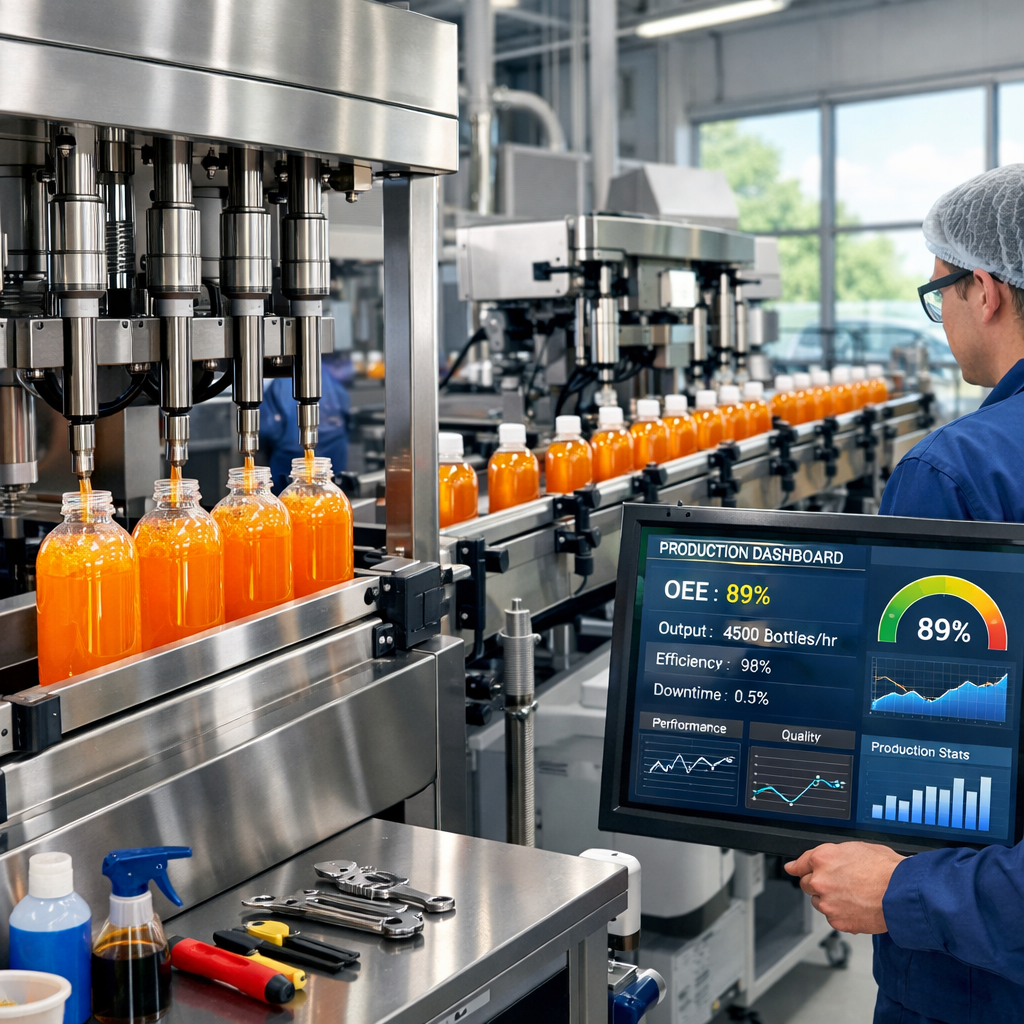
At Apex Filling Systems, We Help Manufacturers Improve Packaging Line Performance
At Apex Filling Systems, we help manufacturers across the food, beverage, chemical, personal care, DEF, distilled spirits, and co-packing industries improve the efficiency and reliability of their packaging operations. While selecting the right filling equipment is important, maximizing its performance over time is equally critical. One of the most effective ways to measure and improve packaging line performance is through Overall Equipment Effectiveness (OEE).
By understanding the factors that influence OEE, manufacturers can identify opportunities to increase throughput, reduce waste, improve product quality, and maximize the return on their equipment investment.
What Is OEE and Why Does It Matter?
Overall Equipment Effectiveness (OEE) measures how effectively manufacturing equipment is being utilized during production. OEE combines three key performance indicators:
- Availability – How often equipment is running when scheduled.
- Performance – How efficiently equipment operates compared to its maximum potential.
- Quality – How consistently the equipment produces acceptable products without defects.
Improving any of these three areas increases overall productivity while reducing operating costs and product waste.
Understanding the Three Components of OEE
Availability
Availability measures the amount of scheduled production time that equipment is actually operating.
Factors that reduce availability include:
- Equipment breakdowns
- Unplanned maintenance
- Material shortages
- Extended changeovers
- Operator delays
Improving equipment reliability and reducing downtime has a direct impact on OEE.
Performance
Performance measures how efficiently equipment operates while running.
Performance losses often result from:
- Reduced operating speeds
- Frequent minor stops
- Product jams
- Operator adjustments
- Inconsistent product flow
Optimizing equipment settings and maintaining smooth production flow helps improve this metric.
Quality
Quality measures the percentage of products that meet specifications without requiring rework or rejection.
Common quality losses include:
- Incorrect fill volumes
- Leaking containers
- Improper cap torque
- Labeling errors
- Damaged containers
Reducing defects increases both customer satisfaction and profitability.
Identify Your Biggest Sources of Downtime
Many manufacturers focus on increasing production speed before addressing downtime.
However, reducing downtime often produces the greatest improvement in OEE.
Common causes include:
- Equipment failures
- Waiting for materials
- Changeovers
- Cleaning procedures
- Operator intervention
- Mechanical adjustments
Tracking downtime by category helps prioritize improvement efforts.
At Apex Filling Systems, production goals, maintenance requirements, and operator workflows are considered when designing integrated packaging solutions.
Improve Fill Accuracy
Product giveaway impacts both quality and profitability.
Modern filling systems improve accuracy through:
- Servo-driven controls
- Precision flow management
- Recipe-based programming
- Real-time monitoring
Improved fill accuracy reduces waste while increasing first-pass quality.
Reduce Changeover Time
Frequent product changes can significantly reduce OEE.
Look for equipment featuring:
- Tool-less adjustments
- Automatic recipes
- Quick container guide changes
- Intuitive HMIs
Efficient changeovers increase available production time while reducing operator frustration.
Integrate the Entire Packaging Line
OEE should be evaluated across the entire production line—not just the filling machine.
Bottlenecks often occur between machines.
An integrated line includes:
- Filling equipment
- Capping systems
- Labeling equipment
- Conveyors
- Accumulation tables
- Inspection systems
Proper synchronization reduces idle time while improving production flow.
Leverage Smart Manufacturing Technologies
Modern packaging equipment provides valuable operational insights.
Real-time dashboards allow manufacturers to monitor:
- Production rates
- OEE
- Downtime
- Fill accuracy
- Machine status
- Maintenance alerts
These tools help identify trends before they become larger production issues.
Prioritize Preventive Maintenance
Poorly maintained equipment rarely operates at peak efficiency.
Preventive maintenance helps:
- Reduce breakdowns
- Maintain fill accuracy
- Extend equipment life
- Improve production consistency
- Lower emergency repair costs
A proactive maintenance strategy supports all three components of OEE.
Train Operators for Success
Even advanced automation relies on knowledgeable operators.
Training should include:
- Equipment operation
- Changeover procedures
- Troubleshooting
- Production monitoring
- Basic maintenance
- Safety procedures
Well-trained operators respond more quickly to issues and help maintain consistent production performance.
Measure, Analyze, Improve
Continuous improvement begins with accurate data.
Monitor:
- OEE trends
- Downtime causes
- Reject rates
- Product giveaway
- Changeover duration
- Production throughput
Reviewing these metrics regularly helps identify opportunities for ongoing improvement.
Common Mistakes That Reduce OEE
Measuring only production speed
Speed alone doesn't reflect overall equipment effectiveness.
Ignoring minor stops
Small interruptions often accumulate into significant production losses.
Delaying preventive maintenance
Deferred maintenance frequently results in costly downtime.
Treating each machine independently
Packaging lines perform best when equipment operates as an integrated system.
Failing to collect production data
Without reliable data, improvement efforts become guesswork.
What Information Should You Gather Before Speaking with Apex?
If you're looking to improve OEE, gather the following information before consulting with Apex:
- Current OEE percentage (if available)
- Products being packaged
- Fill volumes
- Container sizes
- Current production speed
- Downtime history
- Changeover frequency
- Reject rates
- Product giveaway estimates
- Existing equipment configuration
- Future production goals
These insights help the Apex team identify opportunities to improve both equipment performance and overall line efficiency.
Frequently Asked Questions
What is a good OEE score for a liquid filling operation?
While benchmarks vary by industry, many manufacturers strive for continuous improvement rather than focusing solely on a single target percentage. Improving availability, performance, and quality over time typically delivers the greatest long-term value.
What has the biggest impact on OEE?
Downtime, inefficient changeovers, product defects, and inconsistent production speeds are among the largest contributors to lower OEE.
How can automation improve OEE?
Automation reduces operator intervention, improves consistency, minimizes downtime, and provides real-time production data that supports continuous improvement.
Should OEE be measured only on the filling machine?
No. OEE should be evaluated across the entire packaging line because bottlenecks often occur between integrated systems.
Can Apex Filling Systems help improve OEE?
Yes. Apex designs integrated filling, capping, labeling, and conveying systems that help manufacturers reduce downtime, improve production efficiency, and maximize equipment performance.
Ready to Improve Your Packaging Line Performance?
Not sure where your biggest opportunities for improvement are?
Use the Apex Equipment Fit Selector to answer a few questions about your products, containers, and production goals. An Apex team member can help identify equipment solutions that improve efficiency, reduce downtime, and support long-term operational success.
About Apex Filling Systems
Apex Filling Systems designs and manufactures liquid filling, capping, labeling, and conveying equipment for manufacturers across the food, beverage, chemical, personal care, DEF, and distilled spirits industries. Every packaging application is unique, and our team works closely with customers to recommend equipment that fits their products, production goals, and future growth plans.
Continue Exploring
Equipment Solutions
Helpful Tools
Related Articles
- How to Identify Bottlenecks in Your Liquid Packaging Line
- The Role of Visual Dashboards in Operator Efficiency
- How to Reduce Operator Error on Filling Lines
- Understanding Servo-Driven Filling Technology: Benefits for Modern Production
- Smart Factories in 2026: What Your Filling Line Needs to Compete
- How to Future-Proof Your Liquid Filling Line Investment
Share this
- Help First (97)
- Apex Filling Systems (78)
- Filling Equipment (76)
- Informational (70)
- Automatic Filling Machine (59)
- Industry Insights (59)
- Packaging Equipment (47)
- About Apex (20)
- American Made Goods (20)
- Fillers (18)
- Automatic Capping (11)
- Apex Filling (10)
- Apex (7)
- Uncategorized (5)
- Apex Team (3)
- Apex Family (2)
- Absolute Truth (1)
- Apex Way (1)
- Petroleum (1)
- oil (1)
- August 2026 (1)
- July 2026 (5)
- June 2026 (4)
- May 2026 (5)
- April 2026 (4)
- March 2026 (4)
- February 2026 (1)
- January 2026 (2)
- December 2025 (4)
- November 2025 (4)
- October 2025 (5)
- September 2025 (3)
- June 2025 (3)
- May 2025 (6)
- April 2025 (10)
- March 2025 (10)
- February 2025 (12)
- January 2025 (14)
- December 2024 (1)
- November 2024 (4)
- October 2024 (4)
- September 2024 (2)
- August 2024 (1)
- July 2024 (4)
- October 2022 (1)
- September 2022 (1)
- June 2022 (1)
- October 2021 (2)
- June 2021 (1)
- May 2021 (1)
- April 2021 (2)
- March 2021 (2)
- February 2021 (1)
- January 2021 (2)
- November 2020 (1)
- October 2020 (1)
- September 2020 (2)
- August 2020 (1)
- July 2020 (1)
- June 2020 (1)
- May 2020 (1)
- April 2020 (2)
- March 2020 (2)
- February 2020 (2)
- January 2020 (3)
- December 2019 (2)
- November 2019 (6)
- October 2019 (4)
- September 2019 (3)
- August 2019 (6)
- July 2019 (2)
- April 2019 (1)
- February 2019 (1)
- January 2019 (7)
- December 2018 (6)
- November 2018 (5)
- October 2018 (2)
- September 2018 (2)
- August 2018 (1)
- July 2018 (3)
- May 2018 (2)
- April 2018 (1)
- March 2018 (2)
- February 2018 (2)
- January 2018 (2)