
Share this
How to Choose the Right Filling Machine for Diesel Exhaust Fluid (DEF)
by APEX Filling Systems on Jul 17, 2026
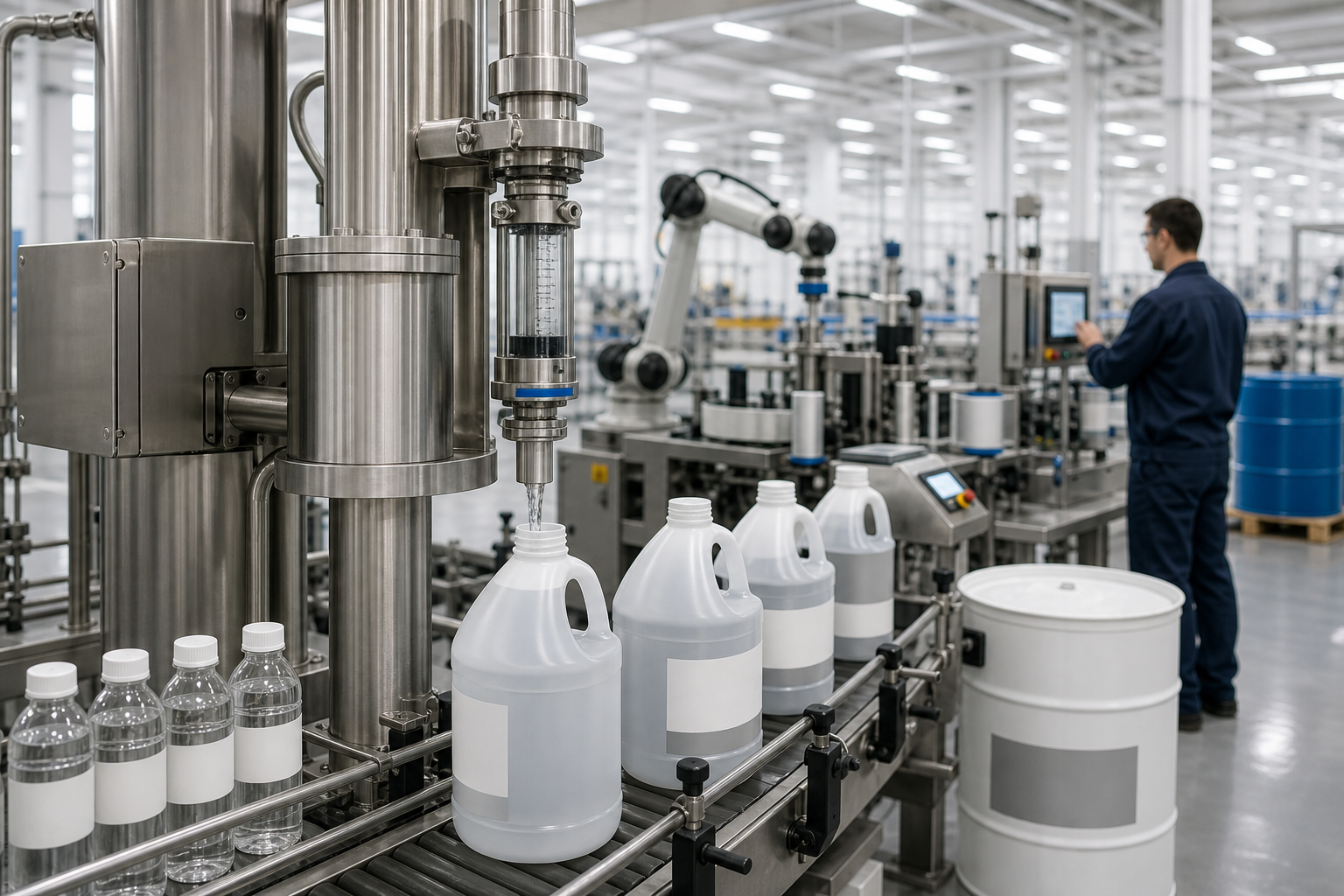
At Apex Filling Systems, We Help Manufacturers Select the Right Equipment for DEF Packaging
At Apex Filling Systems, we help manufacturers package Diesel Exhaust Fluid (DEF), chemicals, lubricants, and other industrial liquids with precision, reliability, and long-term performance. Selecting the right filling machine for DEF requires more than simply choosing a machine capable of dispensing liquid—it requires understanding product purity requirements, material compatibility, production goals, and future expansion plans.
Because DEF is highly sensitive to contamination, the right filling equipment plays a critical role in maintaining product quality while supporting efficient, compliant production.
What Is the Best Filling Machine for Diesel Exhaust Fluid (DEF)?
The best filling machine for Diesel Exhaust Fluid (DEF) is one that combines accurate filling technology with compatible product-contact materials, supports ISO 22241 best practices, integrates with capping and labeling equipment, and can scale alongside future production needs. Manufacturers should evaluate fill accuracy, equipment materials, automation capabilities, container flexibility, and long-term service support before making an investment.
The right solution depends on your specific production environment, container sizes, throughput requirements, and long-term business objectives.
Start with DEF's Unique Requirements
Unlike many industrial liquids, DEF has very specific handling requirements.
DEF consists of:
- 32.5% high-purity automotive-grade urea
- 67.5% deionized water
Although relatively simple in composition, DEF can become contaminated by incompatible materials, chemical residues, or improper handling.
Maintaining product purity should be the primary consideration when selecting any filling system.
Choose Compatible Product-Contact Materials
One of the most important decisions is selecting equipment constructed from materials compatible with DEF.
Common product-contact materials include:
- 304 stainless steel
- 316 stainless steel
- High-density polyethylene (HDPE)
- Polypropylene (PP)
- DEF-compatible seals and elastomers
Using incompatible materials can introduce contamination, reduce product quality, and potentially affect vehicle SCR systems.
At Apex Filling Systems, material compatibility is carefully evaluated to help manufacturers protect product purity throughout the filling process.
Select the Right Filling Technology
Several filling technologies can be used for DEF packaging, but the best choice depends on production goals, container sizes, and desired fill accuracy.
Flow Meter Filling
Flow meter filling systems are a popular option for DEF because they provide:
- Excellent volumetric accuracy
- Consistent repeatability
- Minimal product giveaway
- Flexible fill volume adjustments
These systems are well suited for manufacturers requiring high accuracy across multiple container sizes.
Timed Flow Filling
Timed flow systems may be appropriate for certain DEF applications where production requirements align with this technology.
Benefits include:
- Reliable performance
- Straightforward operation
- Efficient production
Gravity Filling
Gravity filling may also be suitable for some DEF packaging applications depending on product flow characteristics and production requirements.
Choosing the right technology requires evaluating the entire application—not just the product itself.
Consider Your Container Types
DEF is packaged in a wide variety of containers, including:
- Small retail bottles
- One-gallon jugs
- 2.5-gallon containers
- Five-gallon containers
- 55-gallon drums
- IBC totes
- Bulk storage systems
Before selecting equipment, consider:
- Container material
- Neck finish
- Fill volume
- Future container changes
- Number of SKUs
A filling machine designed for flexibility makes it easier to introduce new packaging formats without replacing equipment.
Don't Overlook Capping and Labeling
The filling machine is only one part of the packaging process.
A complete DEF packaging line should also include:
Automated Capping
Proper cap application helps:
- Prevent leaks
- Protect product purity
- Improve package consistency
- Support tamper-evident packaging
Accurate Labeling
Integrated labeling systems improve efficiency while ensuring:
- Product identification
- Regulatory information
- Batch traceability
- Consistent label placement
Integrated packaging lines reduce manual handling while improving overall production flow.
Prioritize Fill Accuracy
Accurate filling is important for every product, but it is especially valuable for DEF.
Precise filling helps manufacturers:
- Reduce product giveaway
- Improve package consistency
- Increase profitability
- Enhance customer satisfaction
Servo-controlled systems and advanced filling technologies help maintain consistent fill volumes throughout production.
Plan for Automation
Many manufacturers initially purchase equipment based on current production needs.
However, automation requirements often increase over time.
Modern DEF packaging lines can incorporate:
- Automatic bottle indexing
- Servo-driven filling
- Automatic capping
- Vision inspection
- Production monitoring dashboards
- Robotic case packing
- Remote diagnostics
Planning for future automation helps protect your equipment investment.
Evaluate Equipment Scalability
Production rarely remains static.
Before investing in a filling machine, consider:
- Expected production growth
- New product introductions
- Additional container sizes
- Retail expansion
- Contract packaging opportunities
Equipment designed for expansion helps avoid premature replacement as production demands increase.
Service and Support Matter
Purchasing a filling machine establishes a long-term relationship with your equipment supplier.
Evaluate:
- Technical expertise
- Parts availability
- Customer support
- Installation assistance
- Operator training
- Preventive maintenance recommendations
Reliable service helps maximize equipment performance throughout its lifecycle.
At Apex Filling Systems, we work closely with manufacturers long after installation, providing ongoing support as production requirements evolve.
Common Mistakes to Avoid
Choosing equipment based only on purchase price
Lower upfront costs can lead to higher operating expenses over time.
Ignoring material compatibility
DEF requires carefully selected product-contact materials to help maintain purity.
Buying only for today's production volume
Scalable equipment provides greater long-term value.
Overlooking complete line integration
Filling, capping, labeling, and conveying systems should work together as a coordinated production line.
Waiting too long to automate
Automation can improve consistency, reduce labor requirements, and simplify future expansion.
What Information Should You Gather Before Speaking with Apex?
To help the Apex team recommend the right DEF filling solution, gather the following information before requesting a consultation:
- Container sizes
- Container material
- Fill volume
- Desired production speed
- Closure type
- Current production challenges
- Required level of automation
- Available floor space
- Existing packaging equipment
- Future production goals
- Planned product expansion
This information helps ensure the recommended solution supports both your current production requirements and future growth.
Frequently Asked Questions
What type of filling machine is best for Diesel Exhaust Fluid?
The ideal filling machine depends on your production goals, container sizes, and accuracy requirements. Flow meter, timed flow, and gravity filling technologies may all be appropriate depending on the application.
Does DEF require stainless steel filling equipment?
Many DEF packaging systems use 304 or 316 stainless steel for product-contact components because these materials help maintain product purity and support long-term equipment reliability.
Can one filling machine package multiple DEF container sizes?
Yes. Many modern filling systems are designed to accommodate multiple container sizes through recipe-based controls and quick changeover features.
Should I automate my DEF packaging line?
Automation can improve fill consistency, reduce operator intervention, increase throughput, and support future production growth. The right level of automation depends on your operation and long-term objectives.
Can Apex Filling Systems design a complete DEF packaging line?
Yes. Apex designs integrated filling, capping, labeling, and conveying systems tailored to each manufacturer's products, production requirements, and future growth plans.
Ready to Find the Right DEF Filling Solution?
Not sure which filling machine is right for your application?
Use the Apex Equipment Fit Selector to answer a few questions about your product, containers, and production goals. An Apex team member can review your information and recommend a filling, capping, labeling, and conveying solution designed specifically for your DEF packaging operation.
About Apex Filling Systems
Apex Filling Systems designs and manufactures liquid filling, capping, labeling, and conveying equipment for manufacturers across the food, beverage, chemical, personal care, DEF, and distilled spirits industries. Every packaging application is unique, and our team works closely with customers to recommend equipment that fits their products, production goals, and future growth plans.
Continue Exploring
Equipment Solutions
Helpful Tools
Related Articles
- Everything Manufacturers Need to Know About Filling Diesel Exhaust Fluid (DEF)
- Why Stainless Steel Matters for DEF Packaging
- Filling Equipment Considerations for Chemical Manufacturers in 2026
- What to Look for in a Liquid Filling Machine in 2026
- How to Future-Proof Your Liquid Filling Line Investment
Share this
- Help First (97)
- Apex Filling Systems (78)
- Filling Equipment (76)
- Informational (70)
- Automatic Filling Machine (59)
- Industry Insights (59)
- Packaging Equipment (47)
- About Apex (20)
- American Made Goods (20)
- Fillers (18)
- Automatic Capping (11)
- Apex Filling (10)
- Apex (7)
- Uncategorized (5)
- Apex Team (3)
- Apex Family (2)
- Absolute Truth (1)
- Apex Way (1)
- Petroleum (1)
- oil (1)
- August 2026 (1)
- July 2026 (5)
- June 2026 (4)
- May 2026 (5)
- April 2026 (4)
- March 2026 (4)
- February 2026 (1)
- January 2026 (2)
- December 2025 (4)
- November 2025 (4)
- October 2025 (5)
- September 2025 (3)
- June 2025 (3)
- May 2025 (6)
- April 2025 (10)
- March 2025 (10)
- February 2025 (12)
- January 2025 (14)
- December 2024 (1)
- November 2024 (4)
- October 2024 (4)
- September 2024 (2)
- August 2024 (1)
- July 2024 (4)
- October 2022 (1)
- September 2022 (1)
- June 2022 (1)
- October 2021 (2)
- June 2021 (1)
- May 2021 (1)
- April 2021 (2)
- March 2021 (2)
- February 2021 (1)
- January 2021 (2)
- November 2020 (1)
- October 2020 (1)
- September 2020 (2)
- August 2020 (1)
- July 2020 (1)
- June 2020 (1)
- May 2020 (1)
- April 2020 (2)
- March 2020 (2)
- February 2020 (2)
- January 2020 (3)
- December 2019 (2)
- November 2019 (6)
- October 2019 (4)
- September 2019 (3)
- August 2019 (6)
- July 2019 (2)
- April 2019 (1)
- February 2019 (1)
- January 2019 (7)
- December 2018 (6)
- November 2018 (5)
- October 2018 (2)
- September 2018 (2)
- August 2018 (1)
- July 2018 (3)
- May 2018 (2)
- April 2018 (1)
- March 2018 (2)
- February 2018 (2)
- January 2018 (2)