
Share this
Smart Factories in 2026: What Your Liquid Filling Line Needs to Compete
by APEX Filling Systems on May 22, 2026
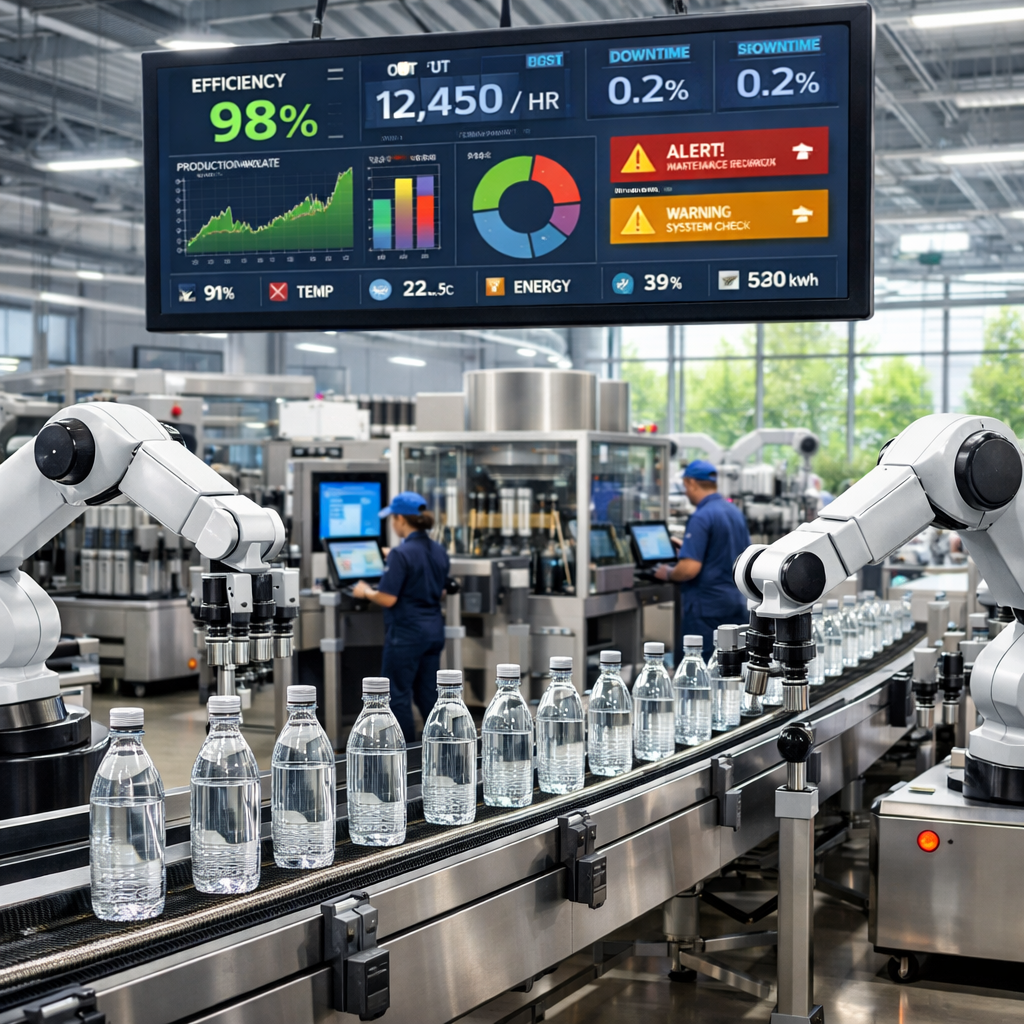
At Apex Filling Systems, We Help Manufacturers Prepare for the Future of Packaging
At Apex Filling Systems, we help manufacturers across the food, beverage, chemical, personal care, DEF, distilled spirits, and co-packing industries build packaging lines that are designed for both current production demands and future growth. Today's manufacturers face increasing pressure to improve efficiency, reduce downtime, address labor shortages, and make data-driven decisions. Smart factory technologies are helping businesses meet those challenges while creating more connected, efficient, and resilient operations.
Preparing your filling line for the future isn't just about adding automation—it's about creating an intelligent production environment where equipment, operators, and data work together to improve performance.
What Is a Smart Factory?
A smart factory uses connected equipment, automation, production data, and digital technologies to monitor, analyze, and optimize manufacturing operations in real time. Rather than relying solely on manual observations or reactive maintenance, smart factories use data to improve decision-making, reduce downtime, increase productivity, and continuously improve production performance.
For liquid packaging operations, this means a filling line that not only fills containers accurately but also provides valuable insights into how the entire production process is performing.
Why Smart Manufacturing Matters in 2026
Manufacturing continues to evolve rapidly.
Today's operations face increasing demands to:
- Increase production without expanding labor
- Reduce downtime
- Improve quality
- Minimize waste
- Respond quickly to production changes
- Improve traceability
- Support sustainability initiatives
Smart manufacturing technologies help address these challenges while creating a more agile production environment.
Connected Equipment Improves Visibility
One of the defining characteristics of a smart factory is equipment connectivity.
Modern packaging equipment can provide real-time visibility into:
- Production rates
- Fill accuracy
- Equipment status
- Downtime events
- Alarm history
- Maintenance schedules
- OEE performance
Instead of waiting for end-of-shift reports, production teams can identify issues as they occur.
Production Dashboards Turn Data into Action
Collecting data is only valuable if it can be understood and acted upon.
Modern dashboards allow manufacturers to monitor:
- Throughput
- Production efficiency
- Changeover performance
- Reject rates
- Product giveaway
- Equipment utilization
Visual dashboards help operators and supervisors make faster, more informed decisions.
At Apex Filling Systems, smart controls and integrated production monitoring can be configured to support each customer's operational goals and reporting needs.
Predictive Maintenance Reduces Downtime
Traditional maintenance often follows one of two approaches:
- Reactive maintenance (fix it after it breaks)
- Scheduled preventive maintenance
Smart factories add a third option:
Predictive Maintenance
By monitoring machine performance, manufacturers can identify early warning signs before equipment failures occur.
Benefits include:
- Reduced unexpected downtime
- Improved maintenance planning
- Lower repair costs
- Longer equipment life
- Increased equipment reliability
Automation Is the Foundation
Automation remains one of the most important building blocks of a smart factory.
Examples include:
- Servo-driven filling systems
- Automatic container handling
- Robotic case packing
- Vision inspection
- Automated palletizing
- Intelligent conveyor systems
Automation improves consistency while creating the production data needed for continuous improvement.
Integration Creates Better Performance
A smart filling line functions as a connected system—not a collection of independent machines.
Integrated equipment includes:
- Filling machines
- Capping systems
- Labeling equipment
- Conveyors
- Inspection systems
- Production software
When these systems communicate with one another, manufacturers gain greater visibility into overall line performance while reducing bottlenecks and manual intervention.
Digital Data Supports Better Decisions
Production data helps manufacturers answer important questions such as:
- Why did production slow yesterday?
- Which shift has the highest OEE?
- Which products experience the longest changeovers?
- Where is product giveaway occurring?
- What equipment requires maintenance next?
Data-driven decision-making allows manufacturers to continuously improve operations instead of relying on assumptions.
Cybersecurity Is Part of Smart Manufacturing
As equipment becomes more connected, cybersecurity becomes increasingly important.
Manufacturers should evaluate:
- Secure remote access
- User authentication
- Software update procedures
- Network segmentation
- Data backup strategies
Working with experienced equipment partners helps ensure connectivity is implemented securely while supporting production goals.
Smart Factories Are Built for Growth
Perhaps the greatest advantage of smart manufacturing is scalability.
Connected equipment allows manufacturers to:
- Expand production more easily
- Add new automation technologies
- Improve reporting
- Integrate future equipment
- Support multiple facilities
Planning for connectivity today helps protect future equipment investments.
Common Mistakes to Avoid
Waiting until equipment becomes obsolete
Modern connectivity can often be incorporated into new equipment today while supporting future expansion.
Collecting data without using it
Dashboards should drive operational improvements, not simply display information.
Viewing automation as only a labor solution
Automation also improves consistency, quality, and production visibility.
Treating machines independently
Smart factories rely on communication between systems.
Ignoring cybersecurity
Connected manufacturing requires secure system architecture from the beginning.
What Information Should You Gather Before Speaking with Apex?
If you're exploring smart manufacturing initiatives, gather the following information before discussing your project:
- Current production speed
- Existing filling equipment
- Current automation level
- Production monitoring capabilities
- OEE metrics (if available)
- Desired reporting requirements
- Existing ERP or MES software
- Current maintenance challenges
- Growth objectives
- Long-term digital manufacturing goals
This information helps the Apex team recommend equipment and automation solutions that support your smart manufacturing strategy.
Frequently Asked Questions
What is a smart factory?
A smart factory is a manufacturing environment where connected equipment, automation, and production data work together to improve efficiency, quality, and decision-making.
Does every manufacturer need a fully automated smart factory?
No. Many manufacturers begin by adding connected equipment, production dashboards, or automated processes incrementally over time.
How does a smart filling line improve productivity?
Connected equipment provides real-time visibility into production, helping manufacturers reduce downtime, improve fill accuracy, optimize changeovers, and increase Overall Equipment Effectiveness (OEE).
Is predictive maintenance worth the investment?
For many operations, predictive maintenance reduces unexpected downtime, improves maintenance planning, and extends equipment life by identifying potential issues before failures occur.
Can Apex Filling Systems help modernize an existing packaging line?
Yes. Apex works with manufacturers to evaluate existing operations and recommend filling, capping, labeling, conveying, and automation solutions that support long-term smart manufacturing initiatives.
Ready to Prepare Your Packaging Line for the Future?
Not sure where to begin with automation or smart manufacturing?
Use the Apex Equipment Fit Selector to answer a few questions about your products, containers, production goals, and future plans. An Apex team member can help identify equipment solutions that support greater efficiency, connectivity, and long-term growth.
About Apex Filling Systems
Apex Filling Systems designs and manufactures liquid filling, capping, labeling, and conveying equipment for manufacturers across the food, beverage, chemical, personal care, DEF, and distilled spirits industries. Every packaging application is unique, and our team works closely with customers to recommend equipment that fits their products, production goals, and future growth plans.
Continue Exploring
Equipment Solutions
Helpful Tools
Related Articles
- How AI Is Changing Liquid Filling Accuracy and Quality Control
- The Role of Visual Dashboards in Operator Efficiency
- Understanding Servo-Driven Filling Technology: Benefits for Modern Production
- Robotics & Filling Lines: How They're Working Together to Improve Throughput
- Training Operators in Automated Facilities: What Works in 2026
- Maximizing OEE in Liquid Filling Operations: A Practical Guide to Improving Productivity
Share this
- Help First (97)
- Apex Filling Systems (78)
- Filling Equipment (76)
- Informational (70)
- Automatic Filling Machine (59)
- Industry Insights (59)
- Packaging Equipment (47)
- About Apex (20)
- American Made Goods (20)
- Fillers (18)
- Automatic Capping (11)
- Apex Filling (10)
- Apex (7)
- Uncategorized (5)
- Apex Team (3)
- Apex Family (2)
- Absolute Truth (1)
- Apex Way (1)
- Petroleum (1)
- oil (1)
- August 2026 (1)
- July 2026 (5)
- June 2026 (4)
- May 2026 (5)
- April 2026 (4)
- March 2026 (4)
- February 2026 (1)
- January 2026 (2)
- December 2025 (4)
- November 2025 (4)
- October 2025 (5)
- September 2025 (3)
- June 2025 (3)
- May 2025 (6)
- April 2025 (10)
- March 2025 (10)
- February 2025 (12)
- January 2025 (14)
- December 2024 (1)
- November 2024 (4)
- October 2024 (4)
- September 2024 (2)
- August 2024 (1)
- July 2024 (4)
- October 2022 (1)
- September 2022 (1)
- June 2022 (1)
- October 2021 (2)
- June 2021 (1)
- May 2021 (1)
- April 2021 (2)
- March 2021 (2)
- February 2021 (1)
- January 2021 (2)
- November 2020 (1)
- October 2020 (1)
- September 2020 (2)
- August 2020 (1)
- July 2020 (1)
- June 2020 (1)
- May 2020 (1)
- April 2020 (2)
- March 2020 (2)
- February 2020 (2)
- January 2020 (3)
- December 2019 (2)
- November 2019 (6)
- October 2019 (4)
- September 2019 (3)
- August 2019 (6)
- July 2019 (2)
- April 2019 (1)
- February 2019 (1)
- January 2019 (7)
- December 2018 (6)
- November 2018 (5)
- October 2018 (2)
- September 2018 (2)
- August 2018 (1)
- July 2018 (3)
- May 2018 (2)
- April 2018 (1)
- March 2018 (2)
- February 2018 (2)
- January 2018 (2)